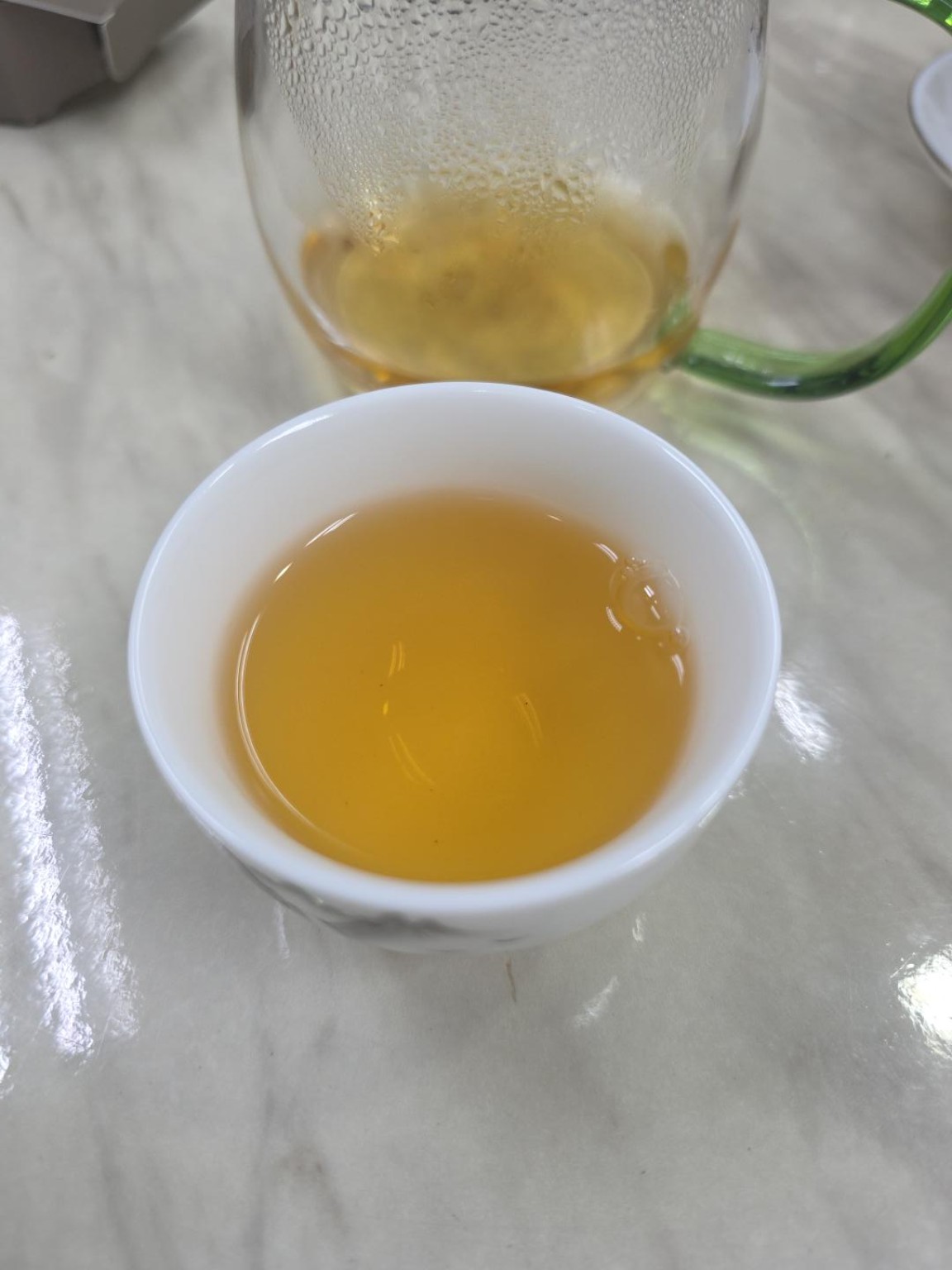
Quick verdict: A minty, refreshing opening develops into raw parsley and vegetable soup with a root-like bitterness. Gentle vegetal sweetness emerges in infusion 4, then settles alongside mild bitterness and a persistent cooling sensation. Ten infusions reveal endurance more than continuing transformation, with golden-yellow colour holding to the end.
Fuding benchmark · Part 3 of 4. Previous: Bai Mu Dan · Series index and brewing comparison. Next: Shou Mei, review to come.
In this review: Tea & Brewing Parameters · Dry Leaf · Warm Gaiwan · Wet Leaf & Liquor · Infusions · Final Wet Leaves · Tasting Scorecard · Closing Reflection
Tea & Brewing Parameters
| Tea | Gong Mei 贡眉 (Gòng Méi) · White tea |
| Brand / product | Mei Bo Zhen 梅伯珍 · Chu Jian 初见 |
| Origin on label | Fuding, Ningde, Fujian, China · 福建省宁德市福鼎市 |
| Raw material on label | Fresh leaves of Fuding population-variety tea plants · 福鼎群体种茶鲜叶 |
| Grade on label | Grade 1 · 一级 |
| Raw-material year | 2025 |
| Production date on packaging | 10 April 2026 (2026/04/10) |
| Producer on label | 福鼎市梅伯珍茶业有限公司 |
| Pack size | 10 g: two 5 g sachets |
| Leaf used | 4.9 g |
| Teaware | Approximately 120 ml gaiwan |
| Water | Volvic Natural Mineral Water |
| Temperature | 95°C for infusions 1–9; 100°C for infusion 10 |
| Rinse | None |
| Infusions | 10 |
| Steeping sequence | 15, 15, 20, 25, 30, 40, 55, 75, 120 and 180 seconds |
The raw-material year and production date are recorded separately, as printed on the packaging. The intended dose was one 5 g sachet; the actual weighed dose was 4.9 g. Brewing times below follow the running tasting record.
This is the third tasting in my Mei Bo Zhen Fuding white-tea benchmark, following Bai Hao Yin Zhen and Bai Mu Dan. The comparisons here describe these particular sessions. This Gong Mei took me through mint, dried flowers and vegetables before settling into a lasting bittersweet vegetal profile. Its most personal moment was a remembrance of food from many years ago. The hero photograph shows the actual second infusion; all photographs in this review are from the tasting session.


Dry Leaf
A minty overlay, followed by vegetal aroma with dried flowers. The leaves are varied in size and colour: larger mature leaves and stems, with some visible buds, ranging from green and olive to brown.

Warm Gaiwan
Lid: Slightly minty.
Cup: Dried leaves and flowers.
Wet Leaf & Liquor
After the first infusion, the lid smells of vegetable soup with broccoli and green beans, together with the typical white-tea aroma. The cup carries cooked spinach with dried flowers. Some mint is still present.
The first liquor is light golden-yellow. It deepens to a darker golden-yellow in infusion 2, and the colour remains persistent through infusion 10.
Infusions
Infusion 1 — Mint and Dried Flowers
95°C · 15 seconds
Minty and refreshing, with vegetal notes and some dried-floral fragrance and taste. The light golden-yellow liquor leaves a moderately light coating on the tongue, followed by a mildly sweet, vegetal aftertaste.

Infusion 2 — Raw Parsley and More Body
95°C · 15 seconds
The colour darkens to a deeper golden-yellow. The vegetal taste is stronger, like raw parsley, with a slight bitterness that comes and goes. The body is much thicker than in infusion 1. The coating now produces a slightly bitter aftertaste.

Infusion 3 — A Remembrance of Vegetable Soup
95°C · 20 seconds
Vegetal soup with moderately light bitterness. It tastes as though the roots were put in together with the raw vegetables, making them into a soup.
Remembrance, not imagery: This does not give me an imagined scene. It brings back the times, many years ago, when I ate raw celery and carrots and boiled parsley for soup.
Infusion 4 — Vegetal Sweetness Emerges
95°C · 25 seconds
The bitterness mellows and some sweetness appears. It reminds me of the later infusions of Yin Zhen, though it is not as sweet. Vegetal sweetness is the closest description.
Infusion 5 — Bitterness and Sweetness Together
95°C · 30 seconds
Stronger vegetal sweetness. Moderately light bitterness sits together with mild sweetness. There is a strong body and moderate coating across the tongue and palate. The aftertaste is the same as the drink. The minty, cooling sensation is still there.
Infusion 6 — Holding Steady
95°C · 40 seconds
Same as infusion 5. Vegetal sweetness and moderately light bitterness continue together, with the same body, coating, aftertaste and cooling sensation. No new change is noted.
Infusion 7 — The Same, but Lighter
95°C · 55 seconds
The same profile, but lighter. The character remains familiar as the intensity begins to soften.
Infusion 8 — A Softer Continuation
95°C · 75 seconds
Again, the same taste profile, aftertaste and coating, but lighter. The tea continues along the established line rather than taking a new direction.
Infusion 9 — A Stable Late Infusion
95°C · 2 minutes
Same. The lighter vegetal, bittersweet profile and its aftertaste continue without a new development.
Infusion 10 — Persistent Colour
100°C · 3 minutes
Same again, even with the higher temperature and longer steep. The colour is persistent too: the liquor still holds its golden-yellow tone. I end the session here at ten infusions.

Final Wet Leaves
Minty and vegetal, though much lighter than after the first infusion. The opened leaves and stems remain individually distinguishable, with olive-green and brown colouring. No separate final leaf-texture observation was recorded.

Tasting Scorecard — Descriptive Assessment
No numerical ratings were assigned during this session. As in the preceding Bai Mu Dan review, this scorecard records the observed qualities without inventing an overall score.
| Attribute | Session notes |
| Dry leaf aroma | Minty overlay, followed by vegetation and dried flowers. |
| Warm gaiwan aroma | Slight mint on the lid; dried leaves and flowers in the cup. |
| Wet / spent leaf aroma | Initially vegetable soup with broccoli and green beans; cooked spinach, dried flowers and some mint. Final leaves remain minty and vegetal, but much lighter. |
| Floral | Dried flowers in the dry leaf, warm cup and opening infusion. |
| Vegetal / herbaceous | Raw parsley grows stronger in infusion 2; root-like vegetable soup in infusion 3; vegetal sweetness from infusion 4. |
| Fruit | No specific fruit note recorded. |
| Sweetness | Mild in the opening finish; clearer vegetal sweetness from infusion 4 and stronger in infusion 5. Less sweet than the remembered later Yin Zhen infusions. |
| Bitterness | Slight and intermittent in infusion 2; moderately light and root-like in infusion 3; mellows in infusion 4, then coexists with mild sweetness. |
| Astringency | Not separately assessed in the tasting notes. The recorded coating is not automatically treated as astringency. |
| Body / texture | Moderately light tongue coating at the start; much thicker body in infusion 2; strong body with moderate tongue-and-palate coating in infusion 5. |
| Cooling sensation | Minty and refreshing at the opening; explicitly still present in infusion 5, with the established profile continuing thereafter. |
| Aftertaste | Mildly sweet and vegetal initially; slightly bitter in infusion 2; mirrors the bittersweet liquor from infusion 5 and persists as the tea lightens. |
| Longevity | Ten infusions. Stable through infusions 5–6, lighter from infusion 7; no new development at 100°C in infusion 10. Colour remains persistent. |
| Defining remembrance | Eating raw celery and carrots, and boiling parsley for soup many years ago. Remembrance, not imagery. |
Closing Reflection
What stays with me is the combination of cooling mint and a very direct vegetable character. Dried flowers accompany the opening, but raw parsley and the root-like bitterness of vegetable soup give the early middle infusions their identity. By infusion 4, the bitterness begins to mellow. In infusion 5, vegetal sweetness and mild bitterness sit together within a strong body and a coating that reaches both tongue and palate.
The later infusions offer continuity. They become lighter, but the taste, coating and aftertaste hold their shape, and even the final three-minute steep at 100°C brings no major change. This Gong Mei is more persistent than complex in this session. Its most evocative moment is also its simplest: a remembered taste of raw celery, carrots and parsley soup.
Brewing Recommendation
For a repeat of this session, use about 5 g in a 120 ml gaiwan with Volvic Natural Mineral Water, no rinse, and 95°C water. Begin with two 15-second infusions, then extend to 20, 25, 30 and 40 seconds before lengthening the later steeps. The final 100°C infusion tested endurance; it did not uncover another flavour. Ten infusions were sufficient for this review.
Return to the four-tea series · Read the Bai Mu Dan review · How to read the scorecards
发表评论