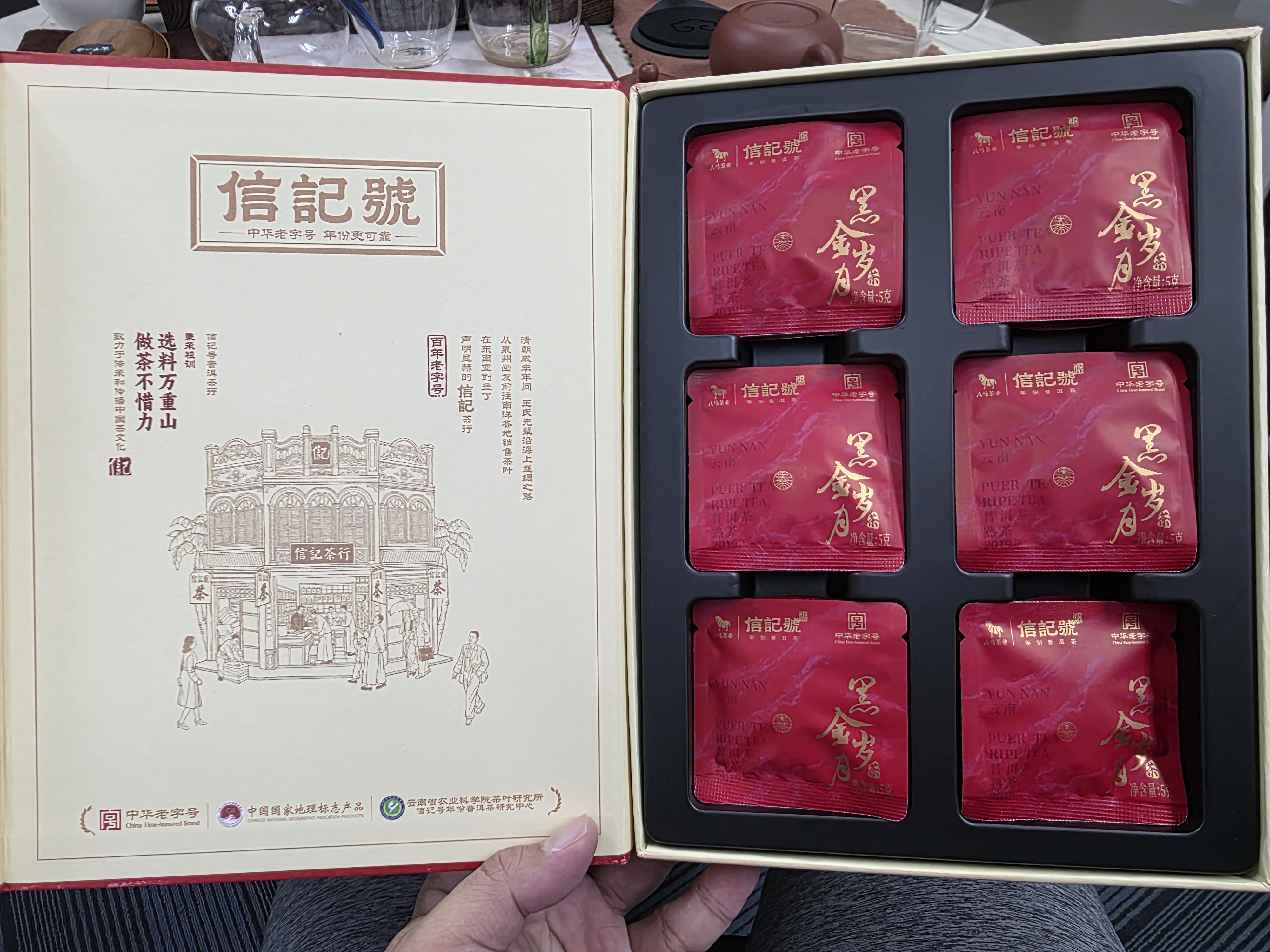
This tea began gently, almost like diluted flower nectar. Within a few infusions, it became a much thicker cup, with a herbal and savoury opening, a distinct ripe Pu’er character and a sweet overlay. What stayed with me was the separation between those three impressions. Even after I extended the later steeps, I felt as though I was drinking three different profiles rather than one integrated tea.
The tea and its provenance
The packaging identifies this as 八马茶业 Bama Tea / 信记号 Xinjihao 黑金岁月 (Heijin Suiyue), product code C1535, a ripe Pu’er (shou / 熟茶). It states that the material is 2019 Yunnan large-leaf sun-dried maocha. The front names Jingmai, Yunnan, as the raw-material area (云南景迈,原料产区), while the rear lists the product origin as Yunnan, Xishuangbanna.
The rear label names Bama Tea Co., Ltd. (八马茶业股份有限公司) as the commissioning company and Yunnan Xinjihao Tea Co., Ltd. (云南信记号茶业有限公司) as the entrusted producer, whose address is in Menghai County, Xishuangbanna. The pack contains 90 g: 18 individually wrapped 5 g pieces.
The package describes dry storage and carries a production date of 21 August 2026. I am keeping those details separate: 2019 refers to the stated raw-material year, while the production date on this package is in 2026. These provenance and storage details are the packaging’s claims; I did not independently verify them.


Brewing setup
| Leaf | One whole mini cake, weighed at 6.1 g |
|---|---|
| Teaware | Porcelain gaiwan, approximately 100–110 ml |
| Water | Volvic |
| Temperature | 100°C |
| Rinse | 10 seconds, discarded |
| Session | 12 infusions |
The little cake was tightly compressed. I brewed it whole and let it open naturally. Although the package calls each piece 5 g, the piece I used weighed 6.1 g. I skipped the warmed dry-leaf step, so I did not record a heated dry-leaf aroma.


Before the first infusion
The dry tea had a restrained ripe Pu’er aroma. After the rinse, the leaves smelled recognisably ripe. On the lid, I found soft cardboard, tree bark and some sweetness. The cup gave me a different set of associations: jujube or dried dates, dried longan and licorice.
The twelve infusions
Infusion 1 — 10 seconds
The liquor was light golden brown. It tasted like diluted flower nectar, with a smooth texture that was easy to swallow. This was a gentle opening, with little indication yet of the stronger savoury character to come.

Infusion 2 — 15 seconds
The colour was slightly darker. A distinct ripe Pu’er taste showed up together with the earlier note. I could still recognise that first cup’s nectar-like impression, but it now had a more obvious shou presence beside it.

Infusion 3 — 15 seconds
The body became noticeably thicker. The liquor hit my palate with a herbal and savoury note—again, like chicken essence. The sweetness enveloped the thick shou body. The coating was mainly on my palate, then my tongue, and the aftertaste was savoury.

Infusion 4 — 15 seconds
The colour turned deep brown. I could follow a clear order: first the mild bitter-savoury notes, then the distinct shou character, then the sweet overlay. The tongue coating became thick, and a bittersweet aftertaste persisted. The chicken-essence association reminded me of my recent 7572 session, although the two shous were remarkably different.

Infusion 5 — 15 seconds
The taste profile stabilised. Around these fourth and fifth infusions, I also noticed that although the liquor was smooth, it clung to my throat. The sides of my tongue had the most sensation, probably connected to the savoury profile.
Infusion 6 — 15 seconds
The taste was the same. I had no new development to add; the established profile continued.
Infusion 7 — 20 seconds
Again, the same profile. Extending the steep slightly did not give me a new direction in the cup.
Infusion 8 — 30 seconds
No change. The bitter-savoury/herbal opening, shou character and sweetness remained recognisable.
Infusion 9 — 55 seconds
I overshot the intended 45 seconds and brewed this cup for 55 seconds. The taste was still the same.
Infusion 10 — 90 seconds
The colour became lighter, but the taste remained the same. This was where I put the central impression into words: “I feel like I’m drinking the three different profiles rather than an integrated tea.” The longer steep had not brought those components together for me.

Infusion 11 — 2 minutes
Same, but diluted. The tea was fading while retaining its familiar structure.
Infusion 12 — 3 minutes
More bland, same taste. The final photograph shows a lighter amber or golden-brown liquor. I ended the session here: there was no new development, just a weaker version of the established profile.

The spent leaves
There was not much smell left, just roast leaves. The leaves were supple. In the photographs, I could see larger leaf and stem material mixed with smaller broken pieces. The tight mini cake had opened substantially over the session.


The comparison with Dayi 7572
Both this tea and my recent Dayi 7572, batch 2101, brought chicken essence to mind, but that shared association does not make them similar overall. I am recalling two separate sessions, rather than describing a side-by-side tasting.
With the 7572, I initially picked out earth, flower petal, root, bark and grass. Later, the chicken-congee image helped me experience those impressions as one thick, warm whole. That was partly a change in how I understood the cup. Here, the three profiles stayed perceptibly separate, even as the longer infusions diluted them.
What stayed with me
The lasting impression was this sequence: bitter-savoury/herbal → characteristic shou → sweet overlay. It followed a gentle nectar-like opening and carried through a stable middle before gradually fading. The smooth liquor, throat cling and strong sensations along the tongue’s sides gave it a clear physical identity too.
发表评论