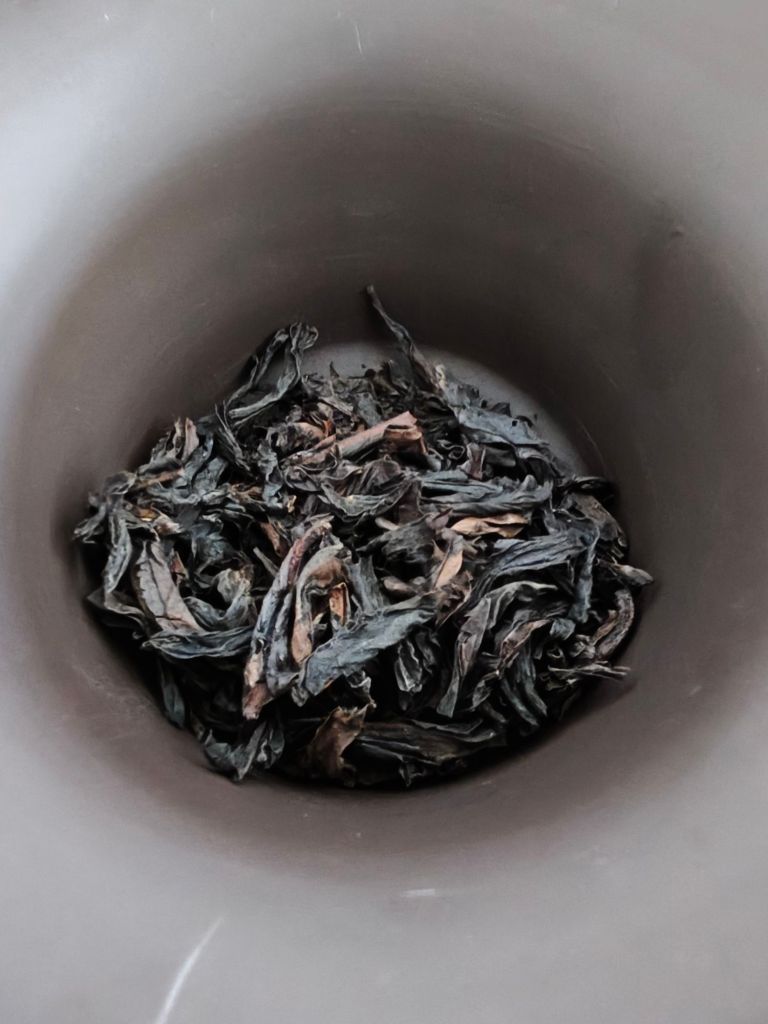
Dry Leaves
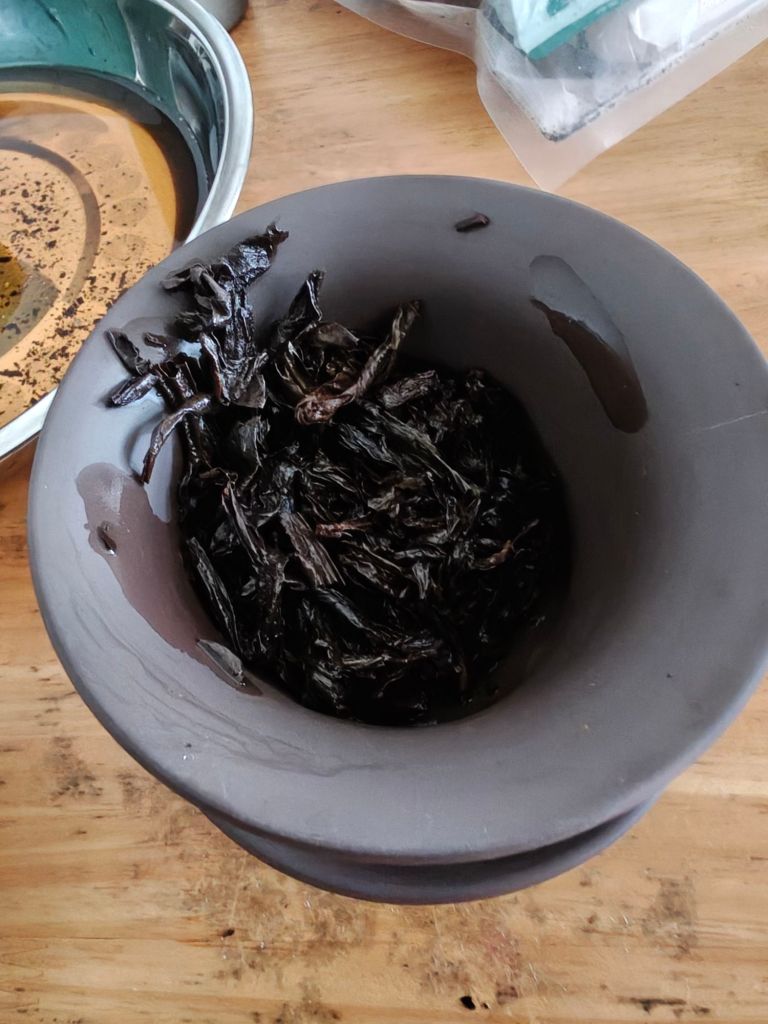
The leaves are fragrant with dried fruits. A moderate sweetness rises immediately, accompanied by dried autumn leaves and a faint sandalwood note. Beneath the obvious aromas lies a quiet complexity that has yet to fully reveal itself.
Warmed Gaiwan
The body of the gaiwan releases roasted notes layered over dried fruits. As the aroma deepens, a surprising touch of camphor emerges from the centre, tying the fragrances together. The lid is quieter, offering only a faint woody scent.
After the Rinse
The rinse softens the dried fruit aroma, pushing it into the background where it remains detectable only when sought deliberately. In its place emerges the scent of sweet forest leaves. The lid reveals faint floral notes previously hidden beneath the darker aromas.
First Infusion
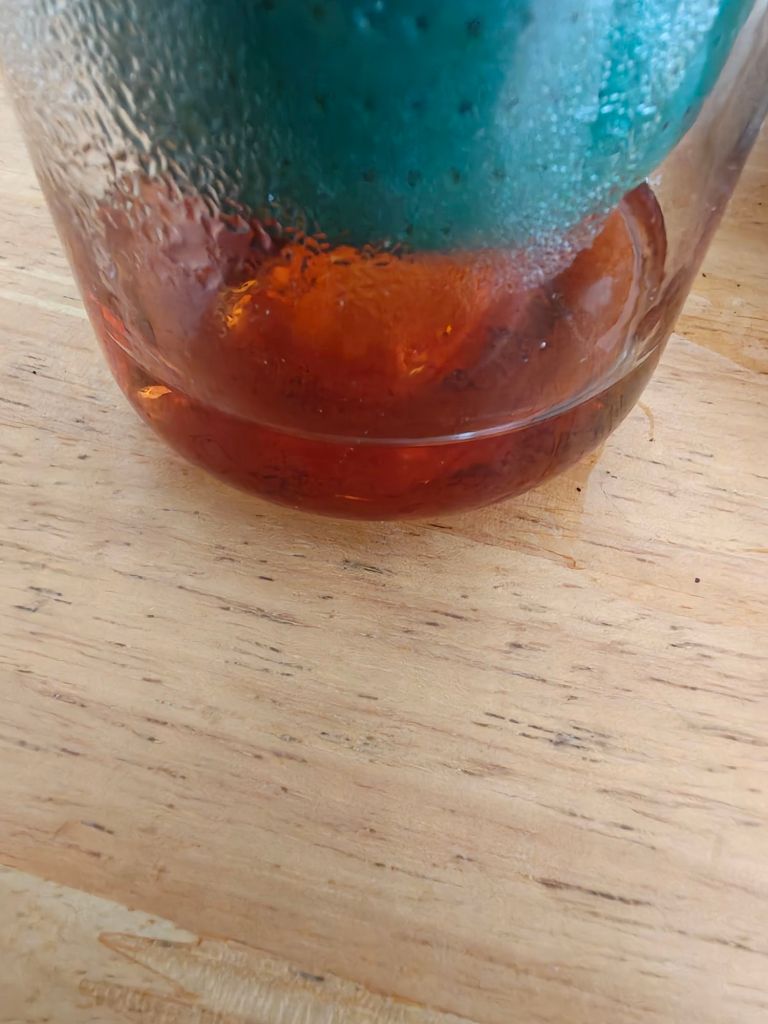
The liquor is a moderate reddish-brown, clear and luminous. It moves across the palate with the smoothness of a light wine. Minerals appear first, lending structure without weight.
I could sip this all day.
Second Infusion
The familiar bittersweet character emerges. The bitterness is neither sharp nor aggressive, but fond and measured. The tongue becomes coated with its flavour, leaving a lingering presence long after the swallow.
Third Infusion
The complexity begins to unfold more clearly now.
It tastes like rainwater slipping quietly into the mouth of a hidden cave, gathering drop by drop into a vessel shaped from dried leaves, fragile yet enduring.
The bowl is placed in my hands by someone who feels strangely familiar.
He is a Chinese man, perhaps in his late forties, with black hair, a neatly trimmed moustache, a short beard, and a belly.
It feels as though I have known him before.
Perhaps years ago.
Perhaps in another life entirely.
I cannot place him.
Yet he recognizes me without hesitation.
The tea offers no explanation.
It simply brings the memory closer.
Fourth Infusion
The cave remains, but its depth feels greater now.
The water seems to rise from somewhere deeper, drawn from a well that has existed far longer than I can comprehend, and it is served in a bowl carved from stone.
The taste resists description.
It is both grounding and elusive, mineral-rich yet softened by a quiet sweetness.
The man stands before me with a weight in his presence that suggests he has witnessed the passing of countless lives.
He offers me the bowl and I accept the bowl and drink.
We do not speak.
Still, something unspoken grows between us.
A quiet understanding.
Beneath the minerals and sweetness lingers the dry, delicate scent of pages from an ancient book.
Fifth Infusion
We sit beside the well.
The bowl becomes clearer now.
Its foundation is stone.
Upon it rests a weave of dried leaves.
Within it lies the well water.
This is the taste.
This is his specialty.
This is what he has chosen to serve me.
Sixth Infusion
One sip.
One word comes to mind.
Salt.
Yet the tea is not salty.
There is simply the presence of salt, as though the water remembers stone.
The old man smiles.
As though to say,
“You are finally getting it.”
Seventh Infusion
The liquor lightens.
The cave remains.
Light now enters from above.
It is midday.
Though it feels as though we have sat beside the well for a very long time.
Another serving is drawn.
The drink is lighter.
Yet somehow more intense.
The essence crystallizes.
Salt.
The old man smiles and nods.
Eighth Infusion
My throat begins to dry, though the water remains smooth.
Then my mouth dries as well.
The old man looks at me.
It is time now.
I understand.
I stand.
I nod.
He nods back.
And I leave.

 worldtea
Leave a comment