In brief: An elegant Ban Tian Yao journey through woody minerality, restrained fruit, floral grace and persistent returning sweetness beneath a mountain grove of drifting petals.
How to interpret the recorded scorecard

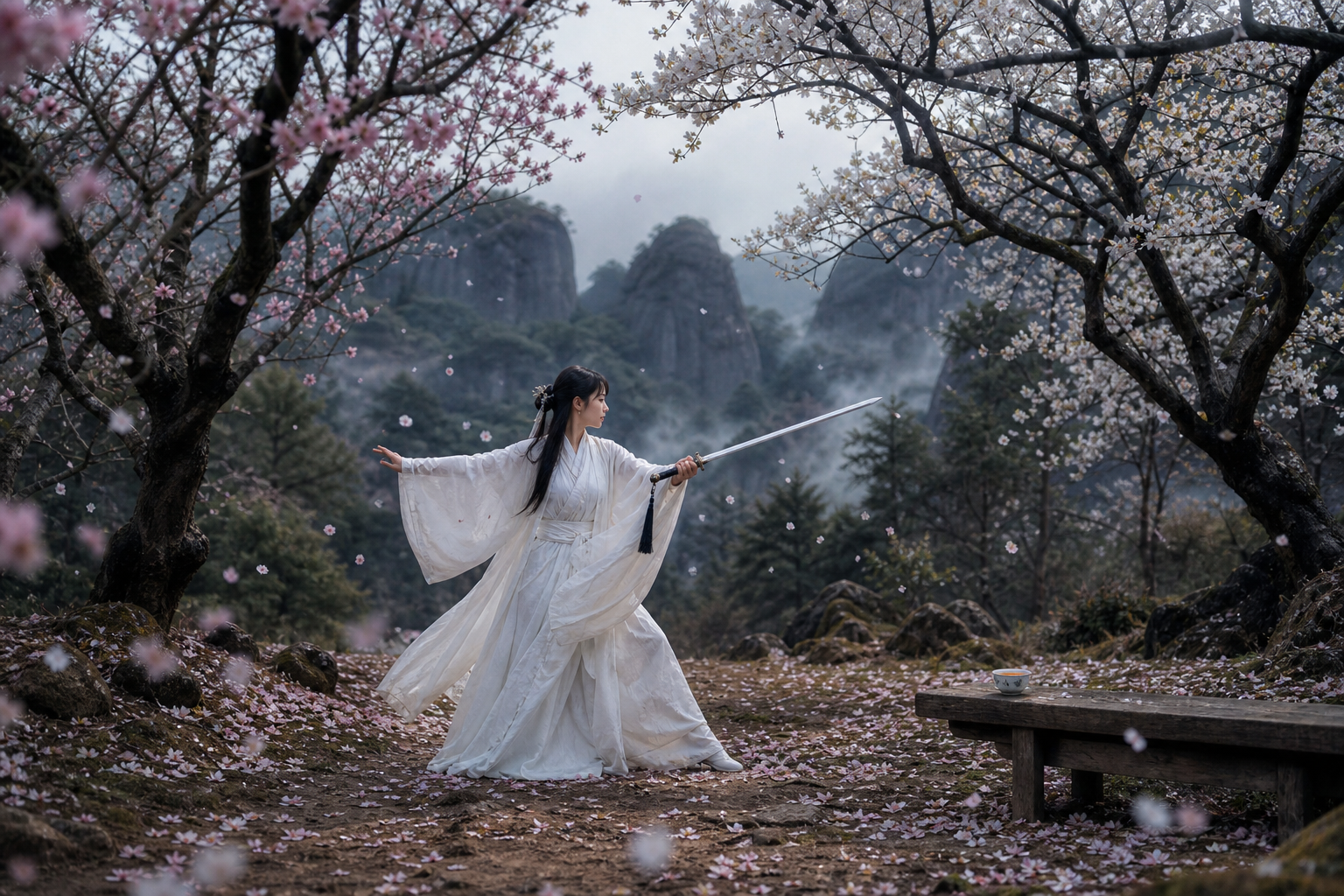
Precision without aggression. Beauty without excess. Beneath the flowering trees, white robes and drifting petals move with the same quiet grace as the tea.
Tea at a Glance
| Tea | Ban Tian Yao |
|---|---|
| Chinese / Pinyin | 半天腰 / Bàn Tiān Yāo |
| Type | Wuyi Rock Tea (Yancha), Oolong Tea |
| Origin | Wuyi Mountains, Fujian, China |
| Cultivar | Ban Tian Yao |
| Overall Score | 7.5/10 |
Brewing Parameters
- Tea: Ban Tian Yao (半天腰)
- Water: Volvic Natural Mineral Water
- Teaware: Mutton Fat Jade Porcelain Gaiwan
- Leaf: 5 g
- Water volume: approximately 100–120 ml
- Temperature: 100°C
- Infusions: 11
Dry Leaf
Appearance
Long, twisted leaves typical of a traditional Wuyi yancha, with a slightly more elongated profile than many other rock teas. The leaves are dark charcoal-brown to black with a moderate sheen, appearing well twisted and largely intact.
Dry Leaf Aroma
A noticeably expressive aroma of floral notes, ripe fruit and gentle traditional roast. Beneath these lies a faint drying astringency that hints at the tea’s underlying structure. Compared with many classic yancha, the fragrance immediately suggests elegance over power.
Warm Gaiwan
Lid
The lid releases ripe fruit intertwined with a gentle roast, creating an inviting and aromatic opening.
Cup
Within the warmed cup, the roast becomes more dominant while the fruit recedes, revealing a warmer and more traditional expression.
After the Rinse
Gaiwan Lid
The fruit deepens and becomes accompanied by a savoury quality and gentle wood, giving the aroma remarkable depth.
Cup
The cup shifts dramatically toward damp forest floor, wet earth and woodland air with a gentle astringency.
Tasting Journey
Infusion 1
Deep amber liquor.
A unique aroma combining wood, rock minerality and a savoury fruit character.
The taste begins with woody minerality before finishing with a gentle sweetness that rises naturally toward the soft palate.
Infusion 2
Rock minerality moves confidently into the foreground.
Woody notes become fuller while a thick floral aftertaste develops after swallowing. The tea begins revealing its elegant structure.
Infusion 3
The palate becomes fully coated.
Gentle fruit emerges for the first time, intertwining naturally with the wood.
The liquor becomes increasingly easy to drink as mild sweetness captures the palate.
The impression is best described as woody fruit.
Infusion 4
Rock minerality becomes the dominant foundation.
Wood and traditional roast follow in equal measure before unfolding into fruit and finally an elegant floral finish.
Both the tongue and soft palate develop a noticeably thicker coating.
Imagery
A woman dressed in flowing white robes practises swordsmanship beneath flowering trees. Pink and white petals drift gently through the air. The ground is mostly bare earth, with only sparse patches of grass scattered among the fallen blossoms.
The woody character reminds me of the Tie Luo Han I reviewed previously, yet here it appears more graceful and beautiful.
Infusion 5
The roast softens into a lighter expression, allowing floral notes to bloom.
Fruit and wood intertwine beautifully beneath the surface.
Returning sweetness becomes one of the tea’s defining strengths, lingering prominently upon the soft palate.
Imagery
The woman continues her graceful sword forms beneath drifting petals.
She is beautiful.
The scenery is beautiful.
The air is beautiful.
Even the taste of the air is beautiful.
Infusion 6
Sweetness arrives first before giving way to woody minerality.
The finish evolves naturally into the taste of flower petals.
Imagery
The woman continues her graceful sword dance beneath the flowering trees. Pink and white petals drift gently through the air, the petals as soft as her features.
Infusion 7
The tea retains its graceful sweetness.
Floral notes remain supported by quiet woody minerality.
The mouthfeel remains smooth and well coated.
Imagery
Her movements are swift yet weightless, flowing naturally like petals carried by the breeze.
As I watch her, I begin to feel lightheaded. Whether it is the beauty of her dance or simply the tea revealing its presence, I cannot tell.
Infusion 8
Rock minerality once again leads before gentle sweetness spreads gradually across the palate.
Imagery
The woman gently sheathes her sword and walks toward a wooden bench beneath the flowering trees.
A cup filled with clear liquid awaits her.
Two petals drift gently into the cup.
She drinks without hesitation and smiles softly, as though the petals had made the water even sweeter.
Infusion 9
Sweetness continues to endure.
Woody floral notes rest comfortably upon a foundation of rock minerality.
The tongue coating gradually begins to thin.
Imagery
She pours herself another cup and drinks it slowly.
Once again, a gentle smile appears upon her face as the sweetness lingers.
She delicately wipes her mouth with a white cloth before quietly setting the cup down.
Infusion 10
The tea gradually softens while sweetness remains remarkably persistent.
Wood, minerality and floral notes quietly linger.
A gentle warmth spreads through my body despite the cool mountain breeze.
Infusion 11
The tea gently fades while faithfully retaining its defining profile of sweetness, wood, minerality and floral elegance.
Imagery
The petals slowly cease their descent.
The woman rises from the bench, retrieves her sword, and returns home.
The gentle breeze continues to flow through the grove.
Combined Tasting (Infusions 1–11)
When combined, the traditional roast once again becomes more prominent.
Wood and rock minerality form the tea’s foundation, while gentle sweet fruit gradually emerges before giving way to a lingering floral finish.
Returning sweetness beautifully unites every element into a remarkably balanced cup.
Wet Leaf Assessment
Appearance
The leaves have opened into long, twisted strips with good elasticity and minimal breakage. Their deep olive-brown colour reflects a well-integrated traditional roast.
The leaves remain relatively fleshy and evenly processed, supporting the tea’s impressive endurance across eleven infusions.
Tasting Scorecard
| Attribute | Score | Notes |
|---|---|---|
| Dry Leaf Aroma | 6.3/10 | Floral fragrance, ripe fruit, gentle traditional roast and faint drying astringency. |
| Wet Leaf Aroma | 6.6/10 | Savoury fruit, warm wood, damp forest floor, wet earth and fresh woodland air. |
| Floral | 6.6/10 | Begins subtly before unfolding into a lingering aftertaste reminiscent of fresh flower petals. |
| Fruit | 6.8/10 | Restrained yet elegant, moving from savoury fruit to gentle sweet fruit integrated with wood. |
| Minerality | 7.9/10 | Strong rock minerality forms the backbone beneath the wood, fruit and floral notes. |
| Sweetness | 8.7/10 | Exceptional returning sweetness (回甘), persistent through the final infusions, especially on the soft palate. |
| Bitterness | 2.0/10 | Very restrained. Structure comes primarily from minerality rather than bitterness. |
| Roast | 6.8/10 | Traditional roast opens the session before gradually softening. |
| Body | 7.5/10 | Medium to full-bodied with good density through the middle infusions. |
| Mouthfeel | 8.3/10 | Excellent silky coating across both the tongue and soft palate. |
| Finish | 8.6/10 | Long, elegant finish of woody minerality, floral notes and persistent sweetness. |
| Yan Yun (Rock Rhyme) | 8.0/10 | Pronounced stone minerality integrates beautifully with wood, floral elegance and sweetness. |
| Longevity | 7.0/10 | Maintained excellent balance across eleven infusions with a gradual, graceful decline. |
| Cha Qi | 6.6/10 | Gentle warming and slight lightheadedness; calm, uplifting and elegant rather than forceful. |
| Overall Impression | 7.5/10 | A refined Ban Tian Yao balancing rock minerality, wood, fruit, floral grace and exceptional returning sweetness. |
Overall Impression
Ban Tian Yao is a tea of refinement rather than force.
Unlike some Wuyi teas that showcase roast or minerality from beginning to end, Ban Tian Yao gradually unfolds into a harmonious balance of rock minerality, wood, restrained fruit, floral elegance and persistent sweetness. Each element appears in quiet succession before eventually becoming inseparable.
The imagery of the woman in white emerged naturally as the tasting progressed. Like her swordsmanship, the tea expresses precision without aggression and beauty without excess. Even as the session draws to a close, it retains its grace.
World Tea Verdict
- Overall: 7.5/10
- Best for: Drinkers seeking elegant yancha, persistent returning sweetness and a refined floral finish.
- Character: Graceful, balanced and approachable.
Brewing Recommendation
Use 5 g of leaf in a 100–120 ml porcelain gaiwan with Volvic Natural Mineral Water at 100°C. Follow the tea through eleven infusions, allowing the early roast and minerality to open into fruit, floral elegance and persistent returning sweetness.
发表回复