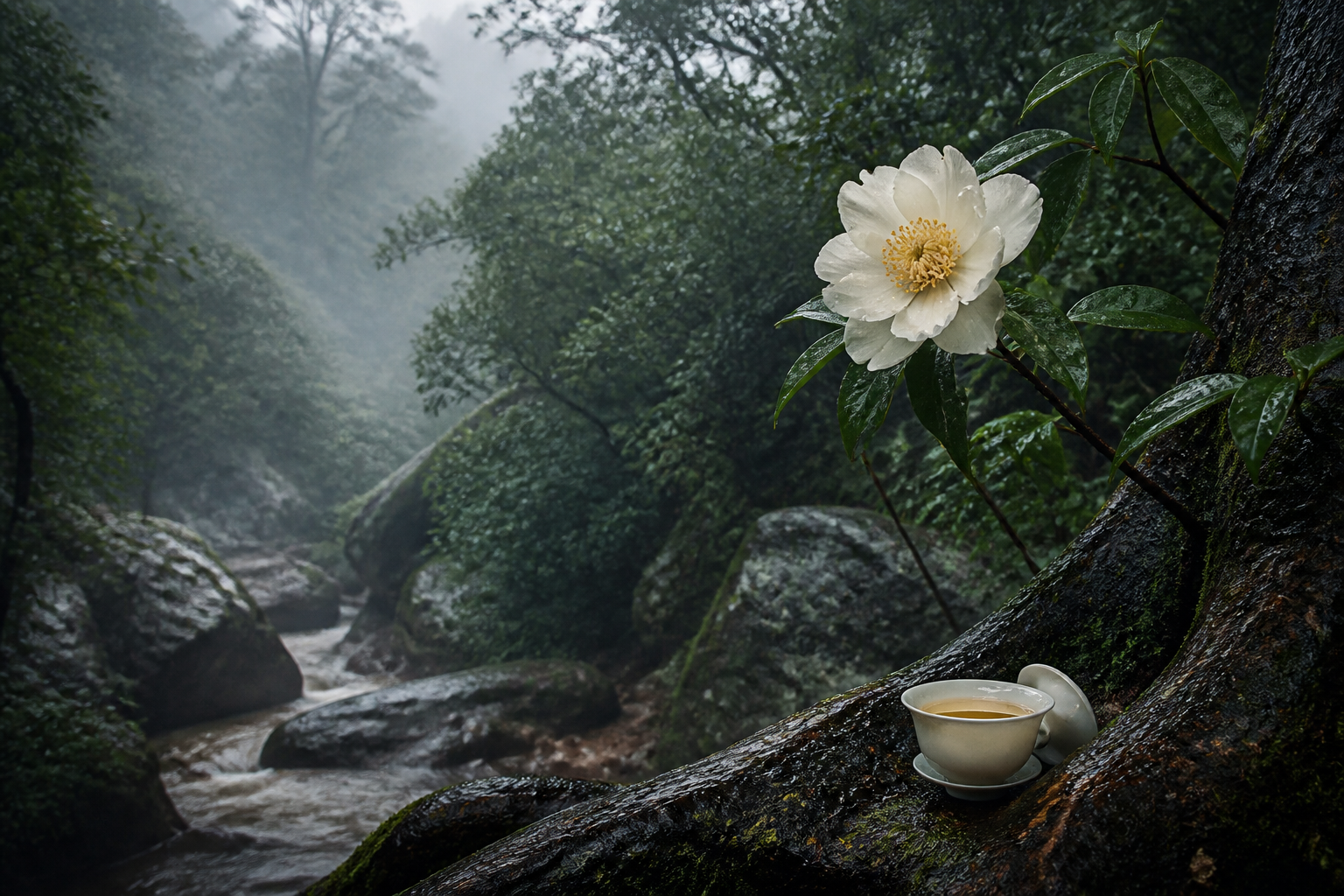
In brief: A fourteen-infusion Jin Mudan journey through Wuyi mist, ancient forest and persistent rock minerality, culminating in sweet wood and a single white flower.
How to interpret the recorded scorecard
“The finest teas do not simply reveal flavour. They reveal a way of seeing.”

Tea at a Glance
| Tea | Jin Mudan |
|---|---|
| Chinese / Pinyin | 金牡丹 / Jīn Mǔ Dān |
| Type | Wuyi Rock Tea (Yancha), Oolong Tea |
| Origin | Wuyi Mountains, Fujian, China |
| Cultivar | Jin Mudan |
| Overall Score | 8.0/10 |
Brewing Parameters
- Water: Volvic Natural Mineral Water
- Teaware: Mutton Fat Jade Porcelain Gaiwan
- Leaf: 5 g
- Water volume: 100–120 ml
- Temperature: 98–100°C
- Infusions: 14
Dry Leaf
The dry leaves are broad, dark brown and tightly twisted, carrying the unmistakable appearance of a Wuyi rock tea.
The aroma reminds me of roasted wood, with subtle hints reminiscent of Phoenix Dan Cong. It is reserved rather than expressive, offering only a quiet glimpse of what is to come.
Warm Leaf
Heating the gaiwan awakens the tea.
Fruit appears first, followed by a gentle roast. Beneath both lies a clean rock minerality, supported by warm wood.
The aromas rise one after another rather than all at once.
After the Rinse
The roast softens noticeably.
The lid carries a gentle drying sensation, while the gaiwan reveals minerality, fruit and a light roast.
The wood retreats into the background.
The forest slowly begins to emerge.
Tasting Journey
Infusion 1
The liquor shines with a clear golden amber.
Rock minerality immediately takes centre stage, accompanied by a gentle roast that reminds me of lightly charred stone rather than heavy charcoal.
The body is smooth, lightly coating the tongue.
The forest has welcomed me.
Infusion 2
The minerality becomes sharper and more focused.
Hints of stone fruit appear, accompanied by a kernel-like bitterness that provides structure without overwhelming the cup.
The liquor now coats both my tongue and hard palate.
The forest grows deeper.
Infusion 3
Rock minerality now becomes the defining character.
A gentle astringency joins the cup while the coating continues to build across the hard palate.
I find myself standing deep within a mountain forest after the rain.
Muddy streams weave between ancient rocks while towering evergreen trees disappear into a thick band of mist suspended halfway through the canopy.
Infusion 4
Minerality and gentle astringency continue to strengthen.
Both settle mainly upon the hard palate, giving the tea remarkable focus.
The air is cool and saturated with moisture.
Yet I remain thirsty.
I instinctively lift my head toward the dense mist itself, longing to drink from it.
Infusion 5
The tea settles into remarkable stability.
Minerality and gentle astringency remain in harmony while a slight roast quietly returns.
I climb onto the broad root of a towering ancient tree, stretching upward in an attempt to lick the drifting mist.
I finally taste the moisture it carries, yet instead of quenching my thirst, it leaves me longing for another sip.
Infusion 6
The minerality thickens.
Woodiness becomes more apparent while the coating grows richer across both my tongue and hard palate.
I take a bite from the mist itself, hoping to quench my thirst.
Instead, an overwhelming thirst consumes me.
Infusion 7
The tea begins to warm my body gently.
Its minerality and woodiness remain steady.
I take yet another bite from the cloud.
The unrelenting thirst returns once again.
Now, with an answer, my mouth begins to salivate.
Infusion 8
The tea softens slightly in the mouth, yet the strength of its character remains unchanged.
Minerality, woodiness and gentle astringency continue in harmony.
I take another bite from the clouds.
Infusion 9
The tea remains remarkably strong.
The woodiness now reminds me of the stalk of a fruit.
The sweetness begins to emerge, and I start to enjoy the drink even more.
As I swallow the tea and my saliva, I understand what the mist is.
The mist is the taste of the forest condensed into a cloud.
It is a self-sufficient forest, quietly serving itself to those who pass by.
Infusion 10
I now perceive the tea in a different form.
Sweet minerality.
I swallow sweet woody liquor.
Infusion 11
The sweetness lingers.
I see a large white flower bloom upon the branch of the ancient tree on which I stand.
Infusion 12
The drink stabilizes.
The focus shifts from the mist to the flower.
It is large with white petals and a yellow centre.
The air smells sweet because of it.
I no longer feel thirsty but satisfied as I breathe in the sweet nectar.
Infusion 13
The sweetness lingers in both the cup and the landscape.
I get down from the tree.
Infusion 14
The flavours gradually fade.
The mist slowly fades, but the flower remains.
I continue my journey.
Combined Infusions (1–14)
Pouring together every infusion produces an entirely different tea.
Roasted nuts, minerality, sweetness, fruit-like astringency and wood all combine, blending into a single harmonious cup.
Every stage of the journey comes together into one complete expression.
Wet Leaves
The spent leaves unfold into a supple bed of deep olive-brown leaves with minimal breakage. They remain resilient after fourteen infusions, reflecting careful processing and a balanced roast.
Their lingering aroma recalls gentle wood, rock minerality and the quiet sweetness that concluded the session.
Tasting Scorecard
| Attribute | Score | Notes |
|---|---|---|
| Dry Leaf Aroma | 7.0/10 | Roasted wood with restrained fruit, reminiscent of Phoenix Dan Cong. |
| Wet Leaf Aroma | 8.3/10 | Minerality, gentle roast, wood and subtle fruit become far more expressive after the rinse. |
| Floral | 5.8/10 | Evident when the leaves were dry but almost absent through most of the session before emerging symbolically in the final infusions. |
| Fruit | 6.8/10 | Present mainly in the aroma during the early infusions before gradually integrating into the tea. |
| Wood | 8.4/10 | A defining characteristic that evolves from roasted wood into the woody sweetness of a fruit stalk. |
| Minerality | 9.2/10 | The backbone of the tea. Clean Wuyi rock minerality grows steadily throughout the session before transforming into sweet minerality. |
| Sweetness | 9.0/10 | Restrained at first before gradually unfolding into one of the tea’s defining characteristics during the later infusions. |
| Astringency | 7.2/10 | Gentle and focused, primarily coating the hard palate. It provides structure without becoming distracting. |
| Roast | 7.2/10 | Present early before integrating naturally into the minerality and wood. |
| Body | 8.3/10 | Smooth, rounded and increasingly substantial without becoming heavy. |
| Mouthfeel | 8.8/10 | A unique coating that extends beyond the tongue onto the hard palate, becoming one of the session’s defining characteristics. |
| Finish | 8.7/10 | Long-lasting sweet minerality with lingering woody sweetness that remains well after swallowing. |
| Yan Yun (Rock Rhyme) | 8.1/10 | Excellent. The rock character deepens throughout the session and remains remarkably persistent, eventually expressing itself as sweet minerality. |
| Longevity | 9.3/10 | Maintained clarity, balance and character across fourteen infusions with only a gradual, graceful decline. |
| Cha Qi | 7.3/10 | A gentle warming sensation that gradually spread through the body. Quiet, calming and reflective rather than forceful. |
| Overall Impression | 8.0/10 | A remarkably coherent Wuyi rock tea whose strength lies in the gradual transformation of minerality into sweetness. |
Final Thoughts
Jin Mudan did not reveal itself through dramatic aromas or sudden changes.
Instead, it unfolded one infusion at a time.
What began as a search for water within the mist became an understanding that the mist itself was the forest’s gift.
By the end of the journey, the thirst had disappeared.
Only the flower remained.
World Tea Verdict
- Overall: 8.0/10
- Best for: Patient sessions and drinkers drawn to persistent rock minerality, structured mouthfeel and late-emerging sweetness.
- Character: Immersive, coherent and quietly transformative.
Brewing Recommendation
Use 5 g of leaf in a 100–120 ml porcelain gaiwan with Volvic Natural Mineral Water at 98–100°C. Allow the tea to unfold patiently across fourteen infusions; its sweetness and floral character become clearest in the later cups.
发表回复