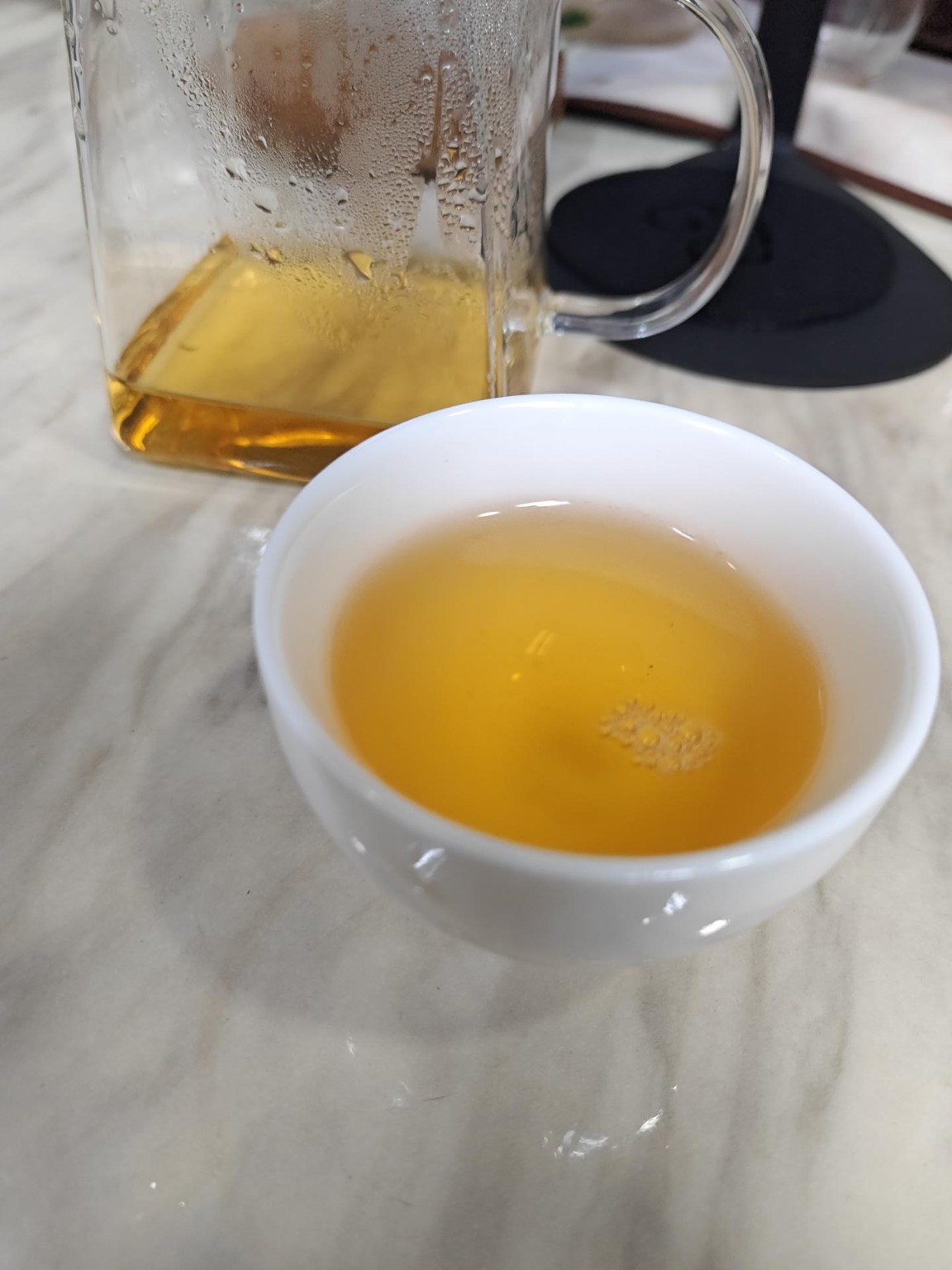
At first, honeysuckle and orchid seem to sit over everything. A few infusions later, it feels like I am biting into an orchid flower. The petal bitterness stays on my tongue, even as the liquor turns sweet. Then the flowers slowly fall away, leaving mashed fresh leaves, morning dew and the sweetness of an unripe plum.
The tea and brewing
The label reads 2021 景迈五百年古树单株(生茶)散茶 — 2021 Jingmai “500-year ancient-tree, single-tree” raw loose tea. The 500-year age and single-tree origin are producer claims, not provenance I have independently authenticated. This review records what I found in the cup.

The leaves were too large for my usual vessel, so I changed to a larger one to avoid breaking them. I used 6.1 g of leaf, 110 ml brewing volume, Volvic mineral water and water at 98°C. After a rinse, I followed the tea through eleven infusions.
Before the first sip
Dry leaves: familiar to 001, but a little more fragrant and clean. Orchid and nectar.
Warm vessel: honeysuckle and orchid on the lid. In the cup, the same orchid-and-nectar character as the dry leaves, only stronger.
After the rinse: the lid stayed close to the warm-vessel fragrance, with honeysuckle standing out. In the cup, the florals mellowed and became more grounded, with some damp dried leaves underneath — what I noted at the time as “wet dry leaves.”
The eleven infusions
1 — Honeysuckle into the liquor
Light golden-yellow. Honeysuckle and orchid carried into the taste. Smooth, with a light tongue coating and a honeysuckle aftertaste.
2 — The flowers stay on the tongue
The colour was almost the same. A honeysuckle overlay covered the underlying Pu’er taste, with a little mellow bitterness appearing ever so slightly. The coating had a distinct aftertaste: almost as though the floral overlay came off the liquor and stayed on my tongue.
This was only my second Jingmai tasting. I wondered whether the character beneath the flowers might be Jingmai, but it was too early for me to identify it confidently as terroir.
3 — Biting into an orchid flower
Now the overlay came with the bitterness. Like biting into an orchid flower. Afterwards, a slight unripe-plum flavour appeared, followed by a sweet aftertaste.
Between infusions three and four, the petal bitterness increased. The coating became thicker, enveloping the whole tongue.
4 — Sweet liquor over a bitter coating
The first sip was like honey. Sweet. I wondered whether the contrast with the bitterness, and how numb my tongue was beginning to feel, made the sweetness stand out more. The liquor reminded me of the later sweet infusions of 2024 Lancang Ancient Tea 001.
One distinction matters here: the floral bitterness was mainly on my tongue as a coating, while the liquor itself tasted sweet. Both sensations were there together. Calling the whole cup bitter would miss what I was experiencing.
5 — The petal bitterness is adamant
The colour was still going strong and seemed a little darker. The sweetness was similar to infusion four; the tea seemed to have stabilised. The petal bitterness was adamant, and my tongue felt numb — like it had been hit by anaesthetics. That is how the sensation felt to me, rather than a claim about what caused it.

6 — Holding steady
Same as five. Sweet liquor, with the persistent petal character in the thick tongue coating and the same numbing sensation.
7 — A little blander
Similar again, but slightly blander. The established profile continued, beginning to lose some intensity.
8 — The overlay recedes
The floral overlay slowly dissipated, exposing more of the underlying character I had been trying to describe. Some sweetness remained. No more bitterness. I thought of this as the tea revealing its “terroir” profile, while keeping in mind how little Jingmai I had tasted so far.
9 — Morning dew
Mashed fresh leaves, morning dew, unripe-plum sweetness. With the floral layer out of the way, these were the associations that came naturally.
10 — The same, but blander
The same profile as nine, only blander. Fresh leaves and morning dew, with the plum sweetness fading.
11 — A quiet ending
Same again. No new turn in the session, just the diluted remains of that late leaf-and-plum character. I stopped here.
The spent leaves
“Mashed wet leaves in spring water.” That was the fragrance at the end. It echoed the mashed fresh leaves and morning dew of the late infusions.

There were many long stems and relatively large, substantially intact leaves, opened to olive and green-brown shades. Several showed prominent veins. The leaf I held up looked fairly substantial rather than paper-thin.

Interesting material to examine, but neither its size nor its appearance proves the label’s 500-year or single-tree claim.
What stays with me
The most memorable part was the separation between the liquor and what it left behind. I could drink sweetness while the orchid-petal bitterness stayed attached to my tongue. That thick coating and almost anaesthetised feeling made the middle of the session very distinct.
Then, once the flowers had faded, the tea became easier for me to describe: mashed fresh leaves, morning dew and unripe-plum sweetness. Eleven infusions took it from orchid and nectar to wet leaves in spring water. That is the progression I want to remember when I drink the next Jingmai.
发表评论