Tasted 28 October 2026 · White Tea / Silver Needle · Personal rating: 7.4/10
I tasted Sunwah Tea’s 2026 Spring Yunnan Silver Needle on 28 October 2026. The first cup was pale, light and led by fragrance: sweet jasmine or orchid, with a little vegetal character behind it. Over the next several infusions, the liquor darkened and the body grew richer while that floral perfume held its place.
I took the same 5 g of buds through seventeen infusions, with a four-hour refrigerated break after the twelfth. Twelve strong infusions were the main achievement. The tea began to decline from the thirteenth, briefly recovered at the fifteenth, then faded again. Even the spent buds retained a mild perfume-like scent. My final rating is 7.4/10.
New to repeated steeping? Each infusion here is another brew of the same 5 g of leaves. A gaiwan is a lidded brewing bowl; body means how full or thick the tea feels in the mouth. Jasmine, orchid and “perfume” describe the aromas and flavours I experienced.
Jump to: Verdict · Brewing · Dry leaves · Spent leaves
Infusions: 1–6 · 7–12 · 13–17
Tea and brewing record
| Tea | 2026 Spring Yunnan Silver Needle |
| Source / packaging | Sunwah Tea |
| Tasting date | 28 October 2026 |
| Leaf | 5.0 g |
| Vessel | Gaiwan; capacity unrecorded |
| Water temperature | Predominantly 90°C; final infusion at 95°C |
| Water | First infusion noted as “old water”; brand/source unrecorded |
| Rinse | Straight to the first infusion; no separate rinse recorded |
| Early steep times | Unrecorded; infusion 12 was left a little longer, without an exact time |
| Late steep times | 14: 1 minute · 15: 3 minutes · 16: 4 minutes · 17: 5 minutes |
| Break | Approximately four hours after infusion 12; wet leaves refrigerated |
| Session | 17 infusions in total |
| Personal rating | 7.4/10 |
These are the conditions I recorded during this tasting. The early infusion timings and vessel capacity were not confirmed, so this is a record of the session rather than a complete recipe to reproduce it.
Dry leaves and aroma
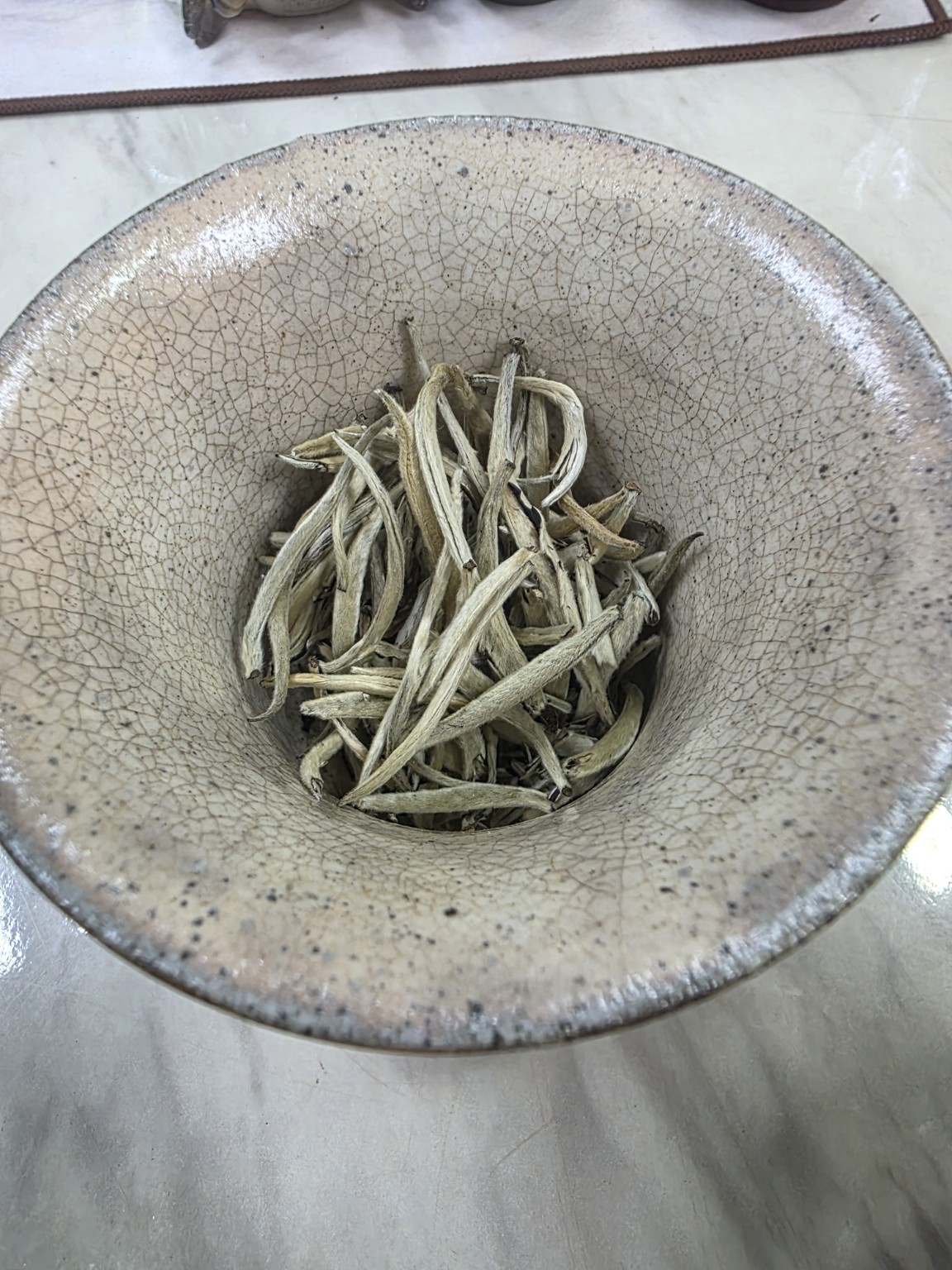
The dry buds were long, slender and slightly curved, with conspicuous silvery-white hairs. Their colours ranged from pale silver and ivory to light straw-gold, with some darker tips. There was variation in length and thickness, along with a few broken tips and small fragments.


Sweet floral fragrance some grassy notes and typical white tea scent
That was my dry-leaf aroma note: floral sweetness, some grassiness and the familiar scent I associate with white tea. I went straight to the first infusion. I did not record a separate rinse or warmed-leaf stage.
The seventeen infusions
Infusion 1 — A light, fragrant opening
At 90°C, the first infusion was very pale yellow. The lid carried a stronger version of the dry-leaf aroma, while the cup smelled sweetly floral and vegetal. The first sip was smooth and sweet, with a jasmine-like scent that I then broadened to jasmine or orchid. The body was light; fragrance was the emphasis.

Infusion 2 — More aroma, a little more body
The second infusion was more aromatic and slightly thicker. It still felt delicate, but there was already a little more substance behind the floral character.
Infusion 3 — Orchid petals
Darker and richer body. Aroma is still there. Now the taste is like orchid petal without the bitterness
The liquor darkened and the body became richer. The floral impression now felt more clearly like orchid petals on the palate, without the bitterness I was using as a point of comparison. The aroma remained present as the tea gained weight.
Infusion 4 — A perfumed drink
Like a perfumed drink. Similar
The profile stayed close to the third infusion. “Perfumed drink” was the most direct way to describe it: that orchid-like floral character was central to the cup.
Infusion 5 — Holding steady
My note was simply “Same.” The established perfume-like floral flavour and body held, with no new change to record.
Infusion 6 — Stable
Again, the tea was stable. The floral character continued without a noticeable shift in taste or body. These middle cups were becoming a test of how long that profile could last.
Infusion 7 — Darker and thicker again
The liquor grew darker and the body thicker still. When I checked the flavour separately, it was similar to the preceding cups. The increasing weight had not displaced the familiar floral character.
Infusion 8 — Amber colour, sustained fragrance
Color like oolong/raw puer now. Very good endurance. Body and taste is thicker but still aromatic
By the eighth infusion, the golden-amber colour reminded me of oolong or raw Pu’er. The comparison was about the colour. The body and taste were thicker, yet the tea remained aromatic. This was a particularly clear expression of its gradual development: more substance, with the floral perfume still intact.

Infusion 9 — The same substantial cup
The ninth infusion stayed much the same as the eighth. The body remained substantial and the orchid-like flavour and fragrance continued. I did not record a decline.
Infusion 10 — Still unchanged
Another “Same” in my notes. Ten infusions in, the fuller body and perfume-like floral profile were still holding.
Infusion 11 — Lighter colour, unchanged taste
The colour began to lighten, but the taste stayed the same. It was a useful distinction in this session: a paler cup had not yet meant a weaker flavour.
Infusion 12 — A longer steep, darker again
I left this infusion a little longer and the colour deepened again towards golden-amber. The exact steep time was not recorded. I checked the taste afterwards and noted that it was stable. This completed twelve strong infusions before the first reported loss of body.
A four-hour pause
After infusion 12, I paused the tasting and refrigerated the wet leaves. The break was approximately four hours. I continued with the same leaves and kept the infusion count running.
Infusion 13 — After the refrigerated break
Same fragrance just very slight decline in body
I resumed after approximately four hours, having refrigerated the wet leaves during the break. The liquor was lighter than the twelfth infusion. The fragrance remained the same, with just a very slight decline in body. This was the first noticeable step down in the drinking progression; I cannot separate the effect of the pause from the effect of repeated brewing.
Infusion 14 — A clearer decline
For the one-minute steep, the tea was declining more clearly. The taste became a little blander and the body lost some of its earlier substance. I did not record a separate aroma assessment for this cup.
Infusion 15 — A temporary recovery
I extended the steep to three minutes and kept the water at 90°C. The liquor darkened again. When I checked the taste and body, my follow-up note was “Restored.” There was a real recovery in the cup, beyond the deeper colour, although it proved temporary.
Infusion 16 — The recovery fades
I tried four minutes at 90°C. The result was similar to infusion 14: blander, with the body declining again. The improvement at the fifteenth infusion did not carry through.
Infusion 17 — The final test
For the last infusion, I raised the water to 95°C and steeped for five minutes. It tasted the same as infusion 16. The longer, hotter finish did not bring back the earlier richness, and I ended the session here.
Spent leaves
Still carry mild perfume smell. Large buds
After seventeen infusions, the large, elongated buds still carried a mild perfume-like fragrance. They had turned olive-brown and tan, with darker areas, and many retained their long, pointed shapes. Their lingering scent was a fitting last observation for a tea whose floral character had stayed so consistent through the session.

Final verdict — 7.4/10
What I will remember is the persistence of the jasmine-orchid perfume and the way the body gradually developed around it. The tea began light and delicate, then became darker and more substantial through the middle infusions. The flavour stayed recognisably floral throughout that development.
Its strength in this session was sustained character. I recorded twelve strong infusions before a slight decline in body at 13 and a clearer loss of flavour at 14. The three-minute fifteenth infusion brought a welcome recovery, but the final two cups showed the limits of the leaves. Seventeen infusions describes the length of the test; the twelve strong cups and the brief recovery at 15 describe the drinking performance more accurately.
A fragrance-led white tea with gradual body development and very good endurance under these brewing conditions. My personal rating: 7.4/10.
发表回复