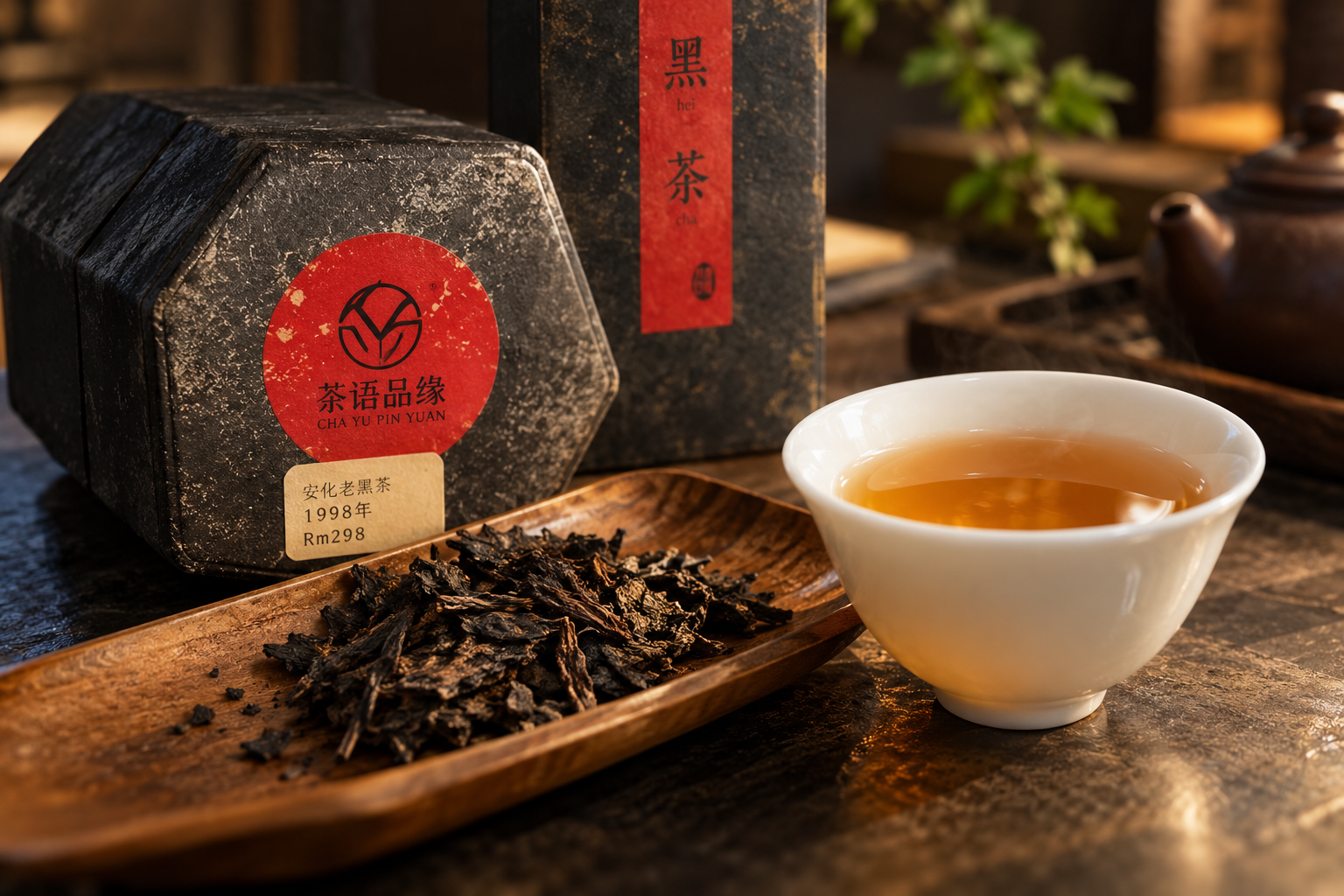
Tasted 28–29 October 2026 · Dark Tea / Hei Cha · Personal rating: 8.0/10
I bought this tea more than ten years ago. The shop where I found it has since closed, but the tea has stayed with me through the ups and downs of the intervening years. Revisiting it felt like sitting down with an old companion.
In the cup: mellow woody sweetness, a smooth texture and a lingering sweet finish. My rating: 8.0/10. The label says 1998; I have not independently verified that year.
During the second infusion, Seasons in the Sun came to mind. The association belonged to the memories surrounding the tea: the years that had passed, the shop that was gone, and this small part of that earlier life still waiting to be brewed. Those feelings made the session meaningful. The tasting notes below record what I actually found in the cup.
Hero image: an AI-generated illustration inspired by this tasting. Original photographs of the brewed tea and spent leaves accompany the notes below.
Jump to: Verdict · Brewing · Label and history
Infusions 1–6 · Infusions 7–10 · Wet leaves
New to repeated brewing? An infusion is one steep of the same leaves. Liquor means the brewed tea, and body means how full it feels in the mouth. Returning sweetness (回甘) is the sweetness noticed after swallowing; salivation means a mouthwatering sensation. Woody, floral and smoky describe my sensory impressions.
What the label says, and what I can confirm
The packaging identifies the tea as 1998 Anhua dark tea (安化老黑茶). The black, hexagonal container carries the name 茶语品缘 (Cha Yu Pin Yuan), and its original price label reads RM298 (Malaysian ringgit). That is the original marked price on the packaging.
The 1998 production year remains unverified. I can confirm that this tea has been in my collection for more than a decade; I cannot independently establish the date printed on its label. Woody flavours, 陈香 (aged fragrance), and the appearance or feel of the leaves do not authenticate that year.
Tea and brewing record
| Tea | Labelled 1998 Anhua dark tea; year unverified |
| Collection history | Owned for more than ten years; the original shop has closed |
| Original marked price | RM298 |
| Leaf quantity | 4.6 g |
| Water | Nongfu Spring (农夫山泉) |
| Temperature | 100°C throughout |
| Opening rinse | Quick rinse, approximately 5 seconds |
| 28 October 2026 | Infusions 1–6: 15, 20, 25, 30, 35 and 40 seconds |
| Overnight pause | Leaves immediately refrigerated after infusion 6; resumed the next morning |
| 29 October 2026 | Infusions 7–10: 45, 50, 60 and 75 seconds |
All ten infusions used the same 4.6 g of leaves. The timings above follow the brewing sequence recorded during the session. The brewing-vessel volume was not recorded, so these details document this tasting rather than provide a complete recipe. The leaves were immediately refrigerated between infusions 6 and 7; the overnight pause is part of the session conditions.
Before the first cup
The dry leaves had almost no detectable smell. Visually, the tea was dark and tightly compressed, with visible stems. After the rinse, the lid smelled predominantly woody, while the empty cup carried earthy and woody notes. Heat and water brought out an aroma that had been difficult to detect in the dry tea.
28 October — Infusions 1–6
Infusion 1 — 15 seconds
The colour reminded me of oolong or mildly aged raw Pu’er. Woody sweetness led the flavour. The tea was mellow and smooth, with a certain depth in its body that I found difficult to put a finger on. I left that impression as an elusive depth rather than assigning it a more specific flavour or calling it complexity.
Infusion 2 — 20 seconds
The liquor darkened and the wood became more obvious. Around it was a surrounding sweetness that I could not confidently identify as woody or herbal. A light coating formed on my tongue, followed by returning sweetness, or 回甘 (hui gan).
Infusion 3 — 25 seconds
A woody-floral fragrance emerged. There was some salivation and returning sweetness. This was the clearest floral moment in my notes, adding another dimension to the wood-led opening.
Infusion 4 — 30 seconds
Bark-like and woody notes came forward, with a sweet aftertaste. The flavour had become easier to describe, settling into a recognisable woody character.
Infusion 5 — 35 seconds
The profile remained the same and stable: bark-like woodiness with a sweet aftertaste. I recorded no distinct new note.
Infusion 6 — 40 seconds
Still stable. The established woody character and sweet finish held their place. I ended the first day here and immediately put the leaves into the fridge for the overnight pause.
29 October — Infusions 7–10
Infusion 7 — 45 seconds
The same profile returned, but it tasted sweeter. That was my observation on resuming the next morning. The session cannot establish whether refrigeration, the longer steep, or a change in perception accounted for the difference.
Infusion 8 — 50 seconds
A slight smoky overlay sat above a woody-sweet base, accompanied by 陈香 (chen xiang, aged fragrance). The body was light and mildly silky. A light coating spread across the palate, with some on the tongue. Salivation was mild, and the aftertaste remained sweet.
Infusion 9 — 60 seconds
The profile remained the same as the eighth infusion: the slight smoky overlay, woody sweetness and aged fragrance continued, along with the light, mildly silky texture and sweet finish. I recorded no new development.
Infusion 10 — 75 seconds
The familiar profile was still recognisable, but it was turning bland. Extending the steep did not restore the earlier expression. This was a natural stopping point for the session.

Wet leaves after ten infusions

The spent leaves were supple and almost scentless. Their pliability was a tactile observation, just as the lack of scent was an aroma observation. Neither establishes the tea’s production year or its earlier storage history.
My assessment — 8.0/10
My impression is of a gentle, enduring tea whose strengths are woody sweetness, a smooth mouthfeel and returning sweetness. The brief floral note and later smoky overlay added interest. Its stable middle infusions made it rewarding to continue, and the decline by the tenth was gradual enough to leave a clear sense of its character.
I would not turn that endurance into a claim about exceptional complexity, nor treat the aged fragrance as proof of the label date. What the session did show was a tea that remained enjoyable through repeated brewing, including a return the next morning, before the familiar flavours began to fade.
My final rating is 8.0/10, based on drinking quality. The memories attached to the tea belong alongside that assessment, without replacing it.
A familiar presence
The shop is gone. More than a decade of my own life has passed since I brought this tea home. Yet there it was again: woody sweetness, a smooth cup, and a quiet reminder of how much can change while something small remains.
That is what Seasons in the Sun brought into this tasting for me. The tea gave me ten infusions; the years I had kept it gave the session another kind of depth.
发表回复