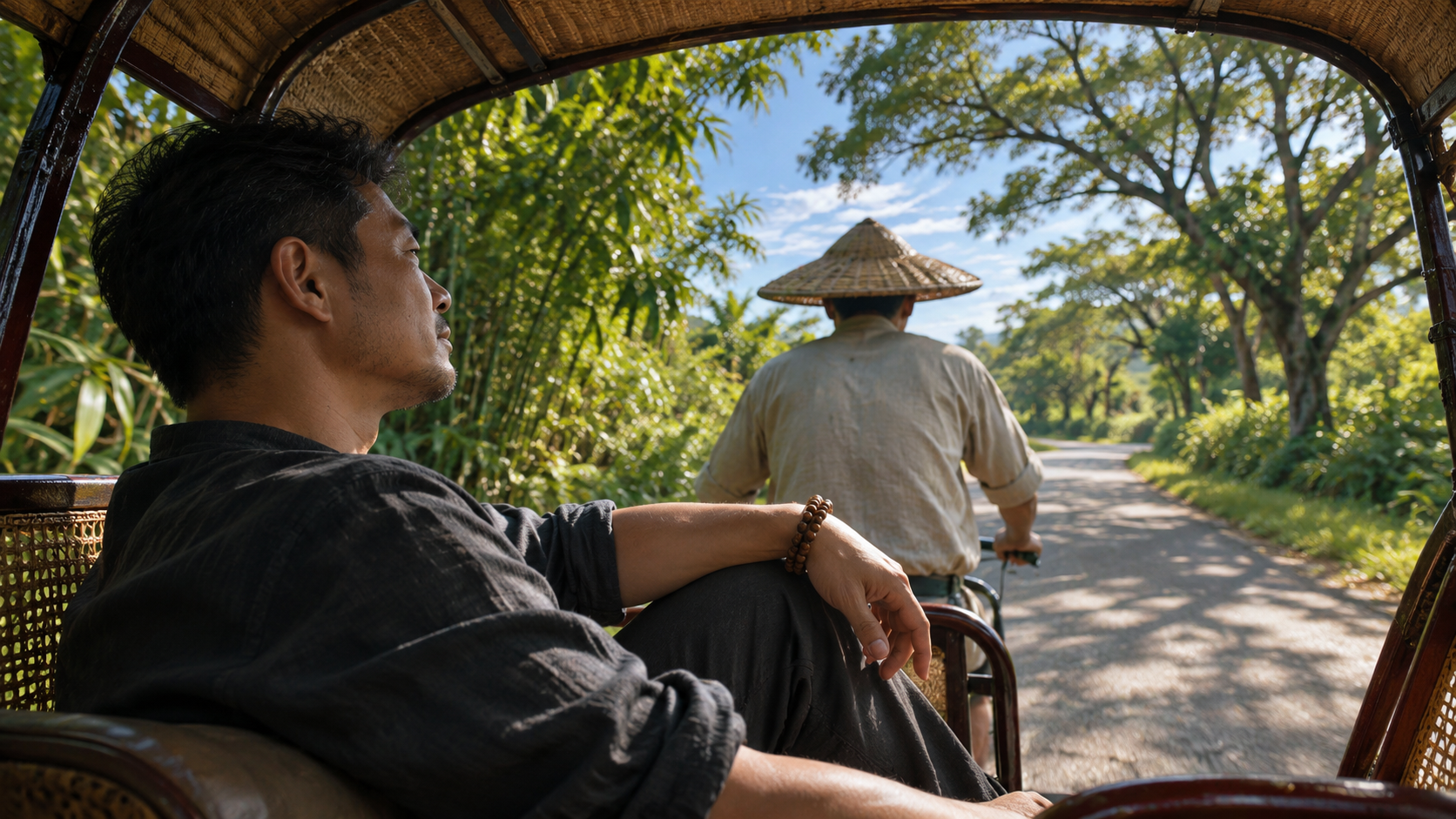
Hero image: the original AI-generated rickshaw illustration created during this tasting.
Heavy roast lay over a deeper 陈香 in this 2017 BAMA 八马茶业 知音·陈香铁观音. Floral notes, a substantial body and returning sweetness gave the early infusions plenty of presence. Its coarse, gripping swallow was surprisingly pleasant, although the tea began losing strength after the fifth infusion. My final rating is 6.3/10.
Alongside the tasting, an image formed in my mind: sitting at the back of a rickshaw, travelling slowly along a green road. At first there was no clear destination. As the session unfolded, peaceful contemplation became gratitude, then reflection on how to continue the journey.
The tea and this session
This is BAMA’s 知音·陈香铁观音, an aged-aroma Tieguanyin from Anxi, Fujian. The packaging identifies 2017 as the raw-material year. The price is unknown, so this review assesses the drinking experience without a value-for-money judgment.
| Tea | 2017 BAMA 八马茶业 知音·陈香铁观音 |
|---|---|
| Style | 陈香型铁观音 · aged-aroma Tieguanyin oolong |
| Origin | Anxi, Fujian, as identified on the packaging |
| Year | 2017, the labelled raw-material year |
| Water | Nongfu Spring (农夫山泉) |
| Temperature and rinse | 100°C; quick rinse |
| Session | Nine infusions |
| Planned steep times | 10, 10, 15, 20, 30, 45, 60, 90 and 120 seconds |
| Price | Unknown |
| Final rating | 6.3/10 |
The planned steep times are listed above; the record does not confirm the timing of every pour. The ninth infusion was taken as an extended two-minute steep. The leaf weight used and vessel capacity were not confirmed in the tasting record.
Select any photograph to view it at full size. Use your browser’s Back button to return to the review.
View packaging photographs (3)


Dry leaves and the rinse
The dry-leaf aroma combined roast with a floral fragrance. After a quick rinse at 100°C, the lid smelled smoky and charred, while the cup carried a heavy roasted-oolong scent. The roasting was unmistakable before the first sip.

Nine infusions
1 — Clear gold, roast above 陈香
The first liquor was clear and golden, with a traditionally roasted scent. Roasted oolong sat at the surface; beneath it I could taste a deeper 陈香, the aged character. These were distinct layers in the cup, with roast providing the immediate impression.
2 — Full body and returning sweetness
By the second infusion, the tea already felt full-bodied for Tieguanyin. I could perceive floral notes through the roast, and the 陈香 was conspicuous. A medium-light coating settled on my tongue. There was dryness and a slight bitterness, followed by returning sweetness.
3 — A coarse, pleasant grip
The golden-amber colour remained stable, as it had since the rinse. A prominent roast overlay sat on a substantial oolong body, with bitter and floral notes and 陈香 at its core. The finish was drying, with moderate tongue coating and a sweet aftertaste.
The swallow clung to my tongue and felt coarse. I enjoyed that tactile grip; it gave this infusion a particular presence. My note at the time was simple: “It is actually pleasant.”


4 — Holding steady
The fourth infusion was stable. The roast, floral and bitter notes, aged core, body and gripping finish continued without a significant change.
This was when I pictured myself sitting at the back of a rickshaw, moving slowly with no clear destination. The sky was bright and blue, but the weather was cool, with a breeze brushing my cheek. The path ahead was clear, with greenery on either side.
I sat contemplating and remembering how I had arrived here, every step along the way. I let the thoughts come and go, like the wind brushing against our path, without needing to make sense of them all.
5 — A little sweeter, a little lighter
The liquor became slightly sweeter and subtly lighter in colour. Otherwise, the tea held its character. The roast, underlying 陈香, floral notes and textured finish remained familiar.
I was enjoying the scenery and feeling at peace: grateful, thankful and appreciative of all I had been through. There was no urgency in the journey.
6 — A quieter cup, beneath the canopy
The liquor was a notch lighter than in the first few infusions. The tea’s characteristics were still present, but it was slightly blander. This was the first clear softening of the session.
In my mind, the path took us beneath a cooler, sheltered canopy. We slowed the pace. Pondering became reflection on the posture I needed to continue this journey along the straight and narrow.
Not just actions and decisions and lessons learnt, but my perpetual posture.
That was the thought I stayed with: the posture I needed to sustain as I continued.
7 — Declining strength, a clearer destination
The tea continued to decline. I could still distinguish its roast, recognisable oolong taste, dryness and coarse swallow, then 陈香 and sweetness. My ranking was by intensity:
Roast > oolong character > dryness/coarseness > 陈香 > sweetness.
These impressions were ranked by how strongly they registered in the cup. Roast remained most prominent as the more subtle qualities receded.
Meanwhile, I began to pick up the pace and continue my journey. The destination was becoming clearer.


8 — Bland
The eighth infusion was bland. There was little of the fullness of the earlier rounds.
9 — No recovery
I took the final infusion as an extended two-minute steep. It was the same as the eighth, if not blander. There was no recovery, and I ended the session here.
Spent leaves
After nine infusions, the leaves were dark, crumpled, thick and supple. Their substantial, pliable texture was clear when I handled them.


Final verdict — 6.3/10
I enjoyed the layered roast and 陈香, the floral hints that remained perceptible through the roasting, and the substantial early body. The returning sweetness was welcome. The coarse swallow was also part of the pleasure of this tea, particularly in the stable early rounds.
Its limits became clear over the full session. Roast stayed dominant, the slight bitterness and drying texture remained noticeable, and the tea had a relatively short stretch at full strength. The first five infusions were the most rewarding; the sixth softened, the seventh continued the decline, and the final two were bland. My rating is 6.3/10.
The rickshaw journey stays with me alongside those tasting notes: a peaceful road without a destination, gratitude for the past, the shelter of the canopy, and reflection on my perpetual posture. Then a renewed pace, with the destination becoming clearer.
More reviews: Tie Guan Yin · Oolong Tea.
发表回复