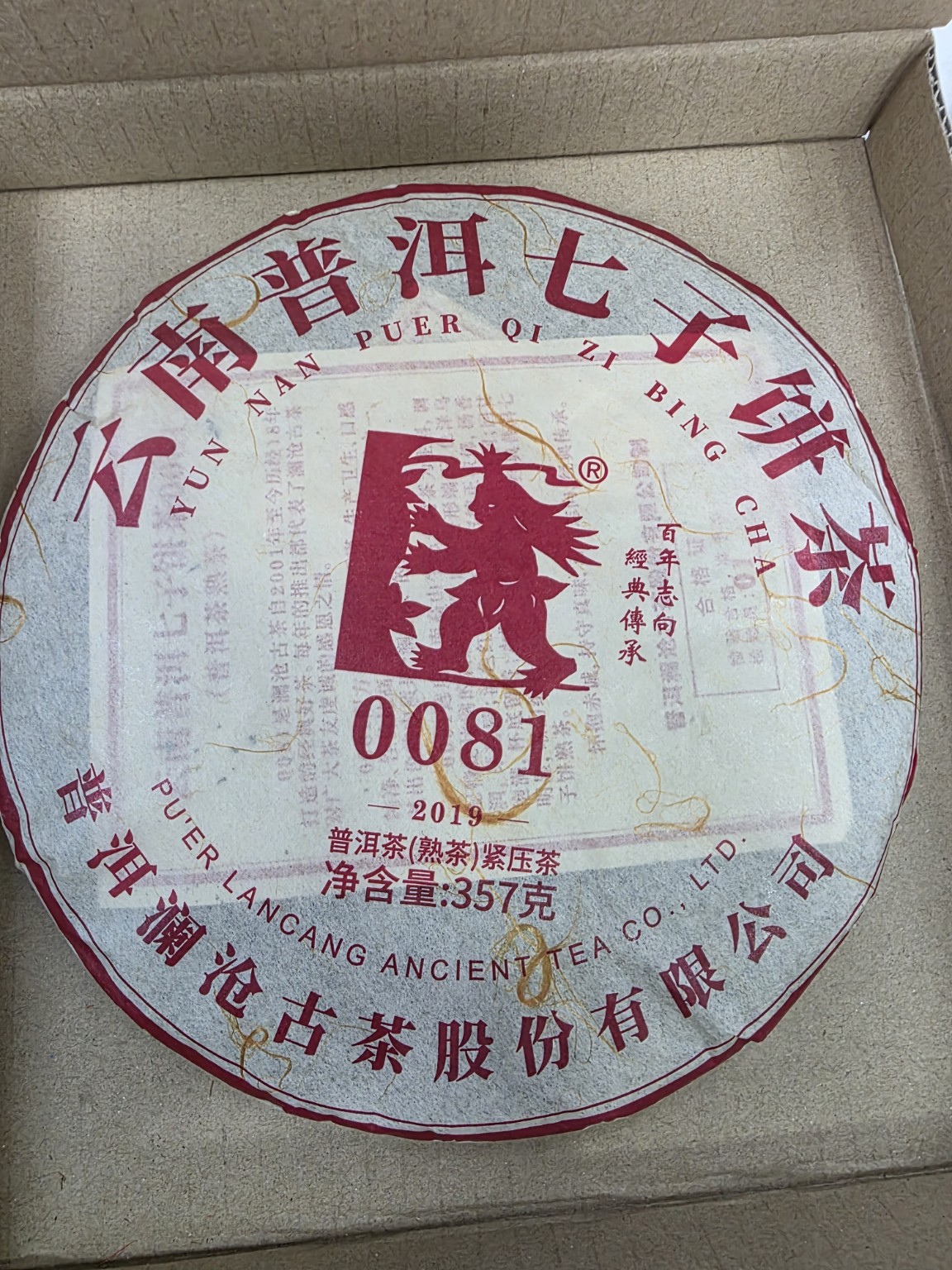
The 2019 Lancang Ancient Tea 0081 opened with familiar ripe Pu’er earthiness, then became more interesting as the session developed. Its best moments combined a thick, smooth body with substantial palate coating, a delicate orchid-petal hint and sweetness reminiscent of honeydew drops. My final rating is 7.6/10, with infusions 3–6 the highlight.
Jump to aromas, tasting notes or the final verdict.
More reviews: Ripe Pu’er · All tea reviews.
The tea and this session
| Tea | Lancang Ancient Tea (澜沧古茶) 0081 |
| Type | Ripe Pu’er (熟普洱) |
| Cake weight | 357 g, as labelled |
| Production date | 3 January 2019, printed on the wrapper |
| Leaf used | 8.3 g |
| Session | 10 infusions tasted; best at 3–6, beginning to decline at 7 |
Select a photo below to view it at full size. Use Back to return to the review.


The unwrapped cake had dark brown leaves with lighter stems visible among the compressed material. I weighed out 8.3 g for this tasting. The production date above is transcribed from the packaging.


Dry and wet aromas
The dry leaves had the usual earthy ripe Pu’er smell. After wetting, the lid carried an earthy and floral fragrance, while the cup offered a distinctly melon-like sweetness. That contrast made the aroma more interesting than the dry leaves alone had suggested.
Infusion-by-infusion tasting
Infusion 1: A smooth, mellow opening
The fragrance was slightly sweeter than I usually find in ripe Pu’er. In the mouth, the tea was earthy, mellow and smooth, with moderate tongue coating.
Infusion 2: Darker and thicker
The liquor became darker and the body thicker. It remained smooth to swallow, with moderate coating and a slight sweetness.


Infusion 3: Body, coating and a long finish
The body thickened further, and the coating became more substantial across both the tongue and the soft palate. Earthiness remained, accompanied by salivation, returning sweetness (hui gan, 回甘) and a long aftertaste. This was where the tea really began to hold my attention.
Infusion 4: An orchid-petal hint
The liquor was very dark. Alongside the earthiness, I found a floral hint like an orchid petal. Deeper in the body, I also sensed a possible chenpi (陈皮, aged tangerine peel) character. I would keep that last impression tentative.

Infusion 5: Honeydew-drop sweetness
The tea became sweeter, reminding me of a less sweetened version of honeydew drops. It echoed the melon sweetness I had noticed earlier in the cup aroma.
Infusion 6: Holding steady
The profile remained stable, retaining the character developed over the preceding infusions. This completed the most enjoyable stretch of the session.
Infusion 7: The first decline
The familiar profile was still present, but it was beginning to decline.
Infusion 8: Bland
The tea became blander, with the earlier flavour intensity fading.
Infusion 9: Sweetness outlasts intensity
Bland, but still sweet. The sweetness persisted after much of the tea’s earlier intensity had faded.

Infusion 10: The end of the session
The final infusion was bland. The leaves were supple, and their fragrance was similar to the earlier wet-leaf aroma, just slightly weaker.
Spent leaves
The spent leaves were very dark, with a mixture of leaf pieces and stems visible in the pot. Their suppleness and the slightly weaker wet-leaf fragrance were my final observations after the tenth infusion.

Final verdict — 7.6/10
What stayed with me was the progression: a smooth, mellow earthy opening; thicker tongue and soft-palate coating with salivation and returning sweetness; then the orchid-petal hint and honeydew-drop sweetness. Infusions 3–6 gave the clearest expression of that character.
Endurance was the main limitation. The tea began declining at infusion 7 and was bland by infusion 8, although sweetness lingered in infusion 9. I enjoyed the middle infusions enough to finish at 7.6/10.
发表回复