In brief: A gifted 2012 Dayi raw sheng whose enduring bitterness matures into structure, comfort and quiet companionship.
How to interpret the recorded scorecard
A gifted 2012 Dayi raw sheng that never abandons its bitterness. Instead, the bitterness matures into structure, comfort and companionship.
Tea at a Glance
| Tea | Dayi Sun-Dried Green Brick |
|---|---|
| Chinese | 大益2012年生茶 / 笋壳青砖 |
| Type | Raw Pu’er (sheng) |
| Producer | Dayi / Taetea, Menghai Tea Factory |
| Origin | Xishuangbanna, Yunnan, China |
| Form | 250 g square brick in bamboo wrapping |
| Production Date | 20 October 2012 |
| Water | Hokkaido Kuromatsunai water |
| Disclosure | Gifted |
| Assessment | Not numerically scored |
First Impression
The liquor opens with restrained bitterness and elusive complexity. Early sweetness is more aromatic than gustatory, while the palate gradually reveals damp autumn leaves, old wood and fleeting camphor.
The bitterness never truly departs. Instead, it evolves into structure rather than obstacle. Strong sheng jin (生津) quenches thirst, smoothness increases with each infusion, and a subtle, non-sweet comfort quietly emerges.
By the final cups, the tea becomes effortless—pleasant as cooled water, gently warming the body, easing a congested nose and leaving the belly quietly satisfied.
It is not a tea of fireworks, but of companionship. Less a performance than a presence.

Brewing Parameters
- Leaf: 5 g
- Water: Hokkaido Kuromatsunai water
- Volume: 100–120 ml
- Temperature: 100°C
- Teaware: Gaiwan
- Infusion timing: Not recorded

Dry Leaf and Packaging
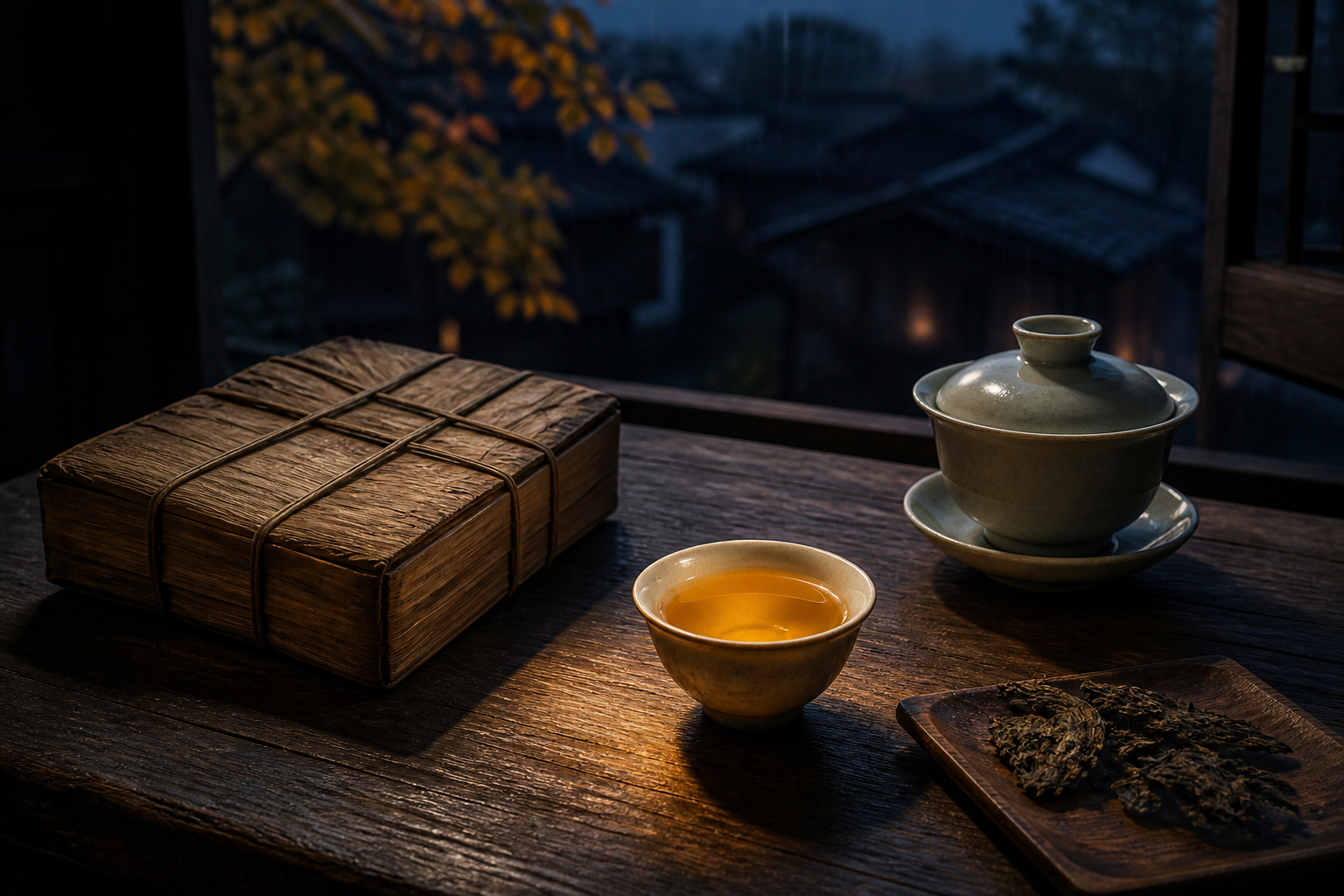
The square brick rests inside traditional bamboo wrapping. Beneath the paper and Dayi ticket, the compressed material appears dark and mature, with visible stems and larger leaves held in a dense, practical form. The presentation feels utilitarian rather than ornamental—a tea built to age, travel and wait.


Tasting Journey
The Opening
The first cup greets me with bitterness. Pleasant, but unmistakable.
I wait for sweetness. For flowers. For dramatic transformations. Instead, the tea offers complexity that refuses to reveal itself all at once.
The Middle Infusions
As the infusions unfold, the tea changes without changing. The bitterness softens, but never disappears. There are hints of camphor, old wood and damp autumn leaves.
My mouth waters. My thirst is quenched. A sweetness emerges, not as flavour, but as comfort.
The Final Cups
By the final cups, the tea has become effortless. Smooth as cooled water. My nose clears. A gentle warmth settles into my body. My belly feels quietly satisfied.
Qualitative Scorecard
| Attribute | Assessment |
|---|---|
| Bitterness | Persistent, restrained and structural rather than aggressive. |
| Sweetness | More aromatic and emotional than overtly gustatory. |
| Aroma | Damp autumn leaves, old wood and fleeting camphor. |
| Mouthfeel | Increasingly smooth, with strong sheng jin and thirst-quenching activity. |
| Body Sensation | Gentle warmth, a clearer nose and quiet satisfaction in the belly. |
| Evolution | Changes without abandoning its central identity. |
| Finish | Effortless and cooling, like pleasant water carrying the memory of bitterness. |
| Character | Companionable, mature and unshowy. |
Strengths
- Persistent bitterness that develops into useful structure.
- Strong salivation and genuine thirst-quenching ability.
- Increasing smoothness across the session.
- Quiet bodily warmth and comfort without demanding attention.
Considerations
- Drinkers seeking obvious sweetness, florality or dramatic transformation may find it restrained.
- The bitterness remains present throughout the session.
- Exact infusion times and total infusion count were not recorded.
Final Reflection — The Bitterness Was Always There
Then I realised: I had been waiting for the tea to become something else.
Sweeter. More obvious. More impressive.
But it never did. Instead, it remained itself.
The bitterness was always there. It simply became easier to live with.
Perhaps maturity is not the absence of bitterness, but learning that bitterness need not dominate. It can coexist with warmth, comfort and peace.
The tea never said, “Look how extraordinary I am.” It simply said, “I am who I am.”
And somehow, that was enough.
World Tea Verdict
- Overall: Not numerically scored
- Best For: Sheng drinkers who value structure, salivation and quiet maturity over spectacle.
- Defining Character: Bitterness transformed into companionship.
- Recommend: Yes, for patient and contemplative sessions.
Brewing Recommendation
Begin with 5 g in a 100–120 ml gaiwan at 100°C. After a quick rinse, keep the opening steeps brief and lengthen gradually. Do not chase sweetness by overextending the early cups; allow the persistent bitterness, salivation and growing smoothness to establish the tea’s natural rhythm.
Related Reading
Disclosure: This tea was gifted.
发表回复