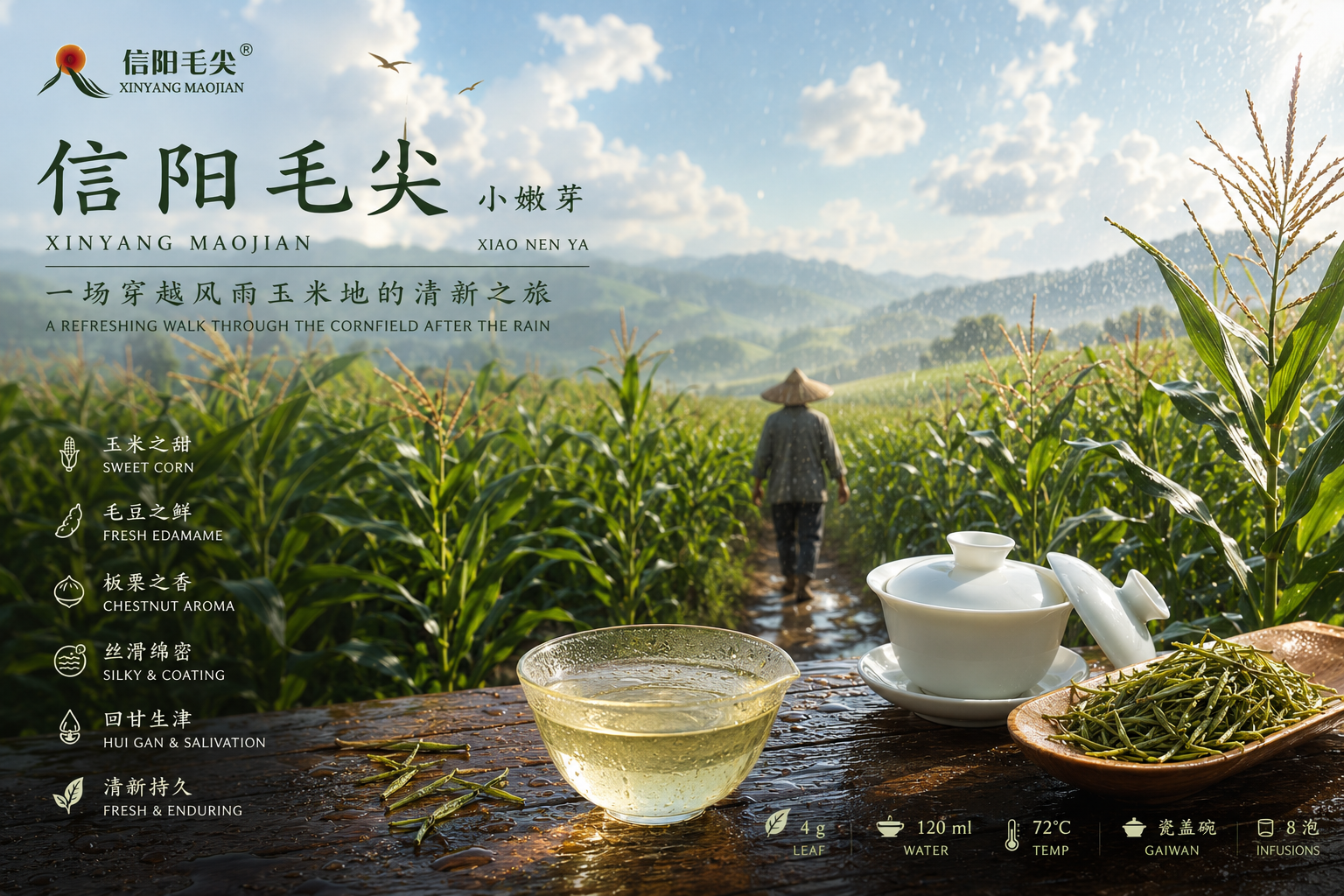
In brief: Xinyang Maojian delivers sweet corn, fresh edamame and chestnut with exceptional clarity, silky texture and remarkable stability across eight low-temperature infusions.
How to interpret the recorded scorecard
A remarkably coherent green tea of sweet corn, fresh edamame and chestnut, carried by a silky-to-syrupy texture through eight unusually stable infusions.
Tea at a Glance
| Tea | Xinyang Maojian — 小嫩芽 |
|---|---|
| Chinese / Pinyin | 信阳毛尖 / Xìnyáng Máojiān |
| Type | Green tea |
| Origin | Xinyang, Henan, China |
| Defining Character | Sweet corn, edamame, chestnut, silky texture and refreshing clarity |
| Overall Score | 85/100 |
Introduction
This Xinyang Maojian is a study in coherence and persistence. Its flavour spectrum is not especially broad, yet sweet corn, fresh edamame and chestnut remain remarkably clear and stable, supported by strong salivation and a silky texture that gradually becomes syrup-like.
At 72°C the tea is particularly graceful: refreshing, gently sweet and almost entirely free from bitterness or astringency. Its inner landscape is a windswept cornfield beneath a blue sky, refreshed by gentle rain.

Brewing Parameters
- Water: Volvic Natural Mineral Water
- Teaware: Porcelain Gaiwan
- Leaf: 4 g
- Water: 120 ml
- Temperature: 72°C
- Rinse: None
- Infusions: 8
Dry Leaf Aroma
Pale vanilla and jasmine: delicate, clean and gently sweet.
Warm Gaiwan
Lid
Chestnut.
Cup
Roasted chestnut and fresh leaves.
Tasting Journey
Infusion 1
The liquor is very pale and clear yellow, with a strong nut-and-corn fragrance. Light, refreshing sweet corn meets a smooth, silky texture that coats the tongue gently.
Infusion 2
The liquor becomes slightly darker. Edamame emerges alongside mildly sweet corn, giving the tea a fresh and gently vegetal character.
Infusion 3
Corn and edamame merge into something resembling a light corn-and-edamame syrup. Salivation develops, particularly over the upper half of the tongue.
Tea imagery: I am in a vast cornfield. The crops sway in a strong but comfortable wind beneath a blue sky with white clouds. Birds chirp and insects make their sounds.
Infusion 4
Colour and flavour remain remarkably stable. Edamame and sweet corn continue with the same light syrup-like quality, while salivation noticeably increases.
Infusion 5
The central profile remains remarkably steady. The tea is gently sweet, clean and pleasantly refreshing.
Tea imagery: A slow drizzle begins while the wind remains comfortable. I open my mouth and rainwater enters—sweet, light and pleasantly refreshing.
Infusion 6
The flavour remains essentially unchanged. The syrupy mouthfeel seems slightly thicker, developing a more substantial coating across the whole tongue.
Tea imagery: I continue walking through the corn farm, taking sips from the air as I walk.
Infusion 7
The liquor colour persists, as does the substantial mouthfeel. A clear sweet aftertaste develops, similar in character to the sweetness of the liquor itself.
Tea imagery: Refreshed and a little more energetic, I exhale and feel some of the tension I was carrying release.
Infusion 8
The liquor finally pales, returning to approximately the colour of the first infusion. The familiar corn-and-edamame character becomes lighter as another, difficult-to-identify flavour overlaps the established profile.
Tea imagery: I leave the place, part of me longing to return soon.
Tasting Scorecard
| Attribute | Score | Notes |
|---|---|---|
| Dry Leaf Aroma | 7.2/10 | Pale vanilla and jasmine; delicate, clean and gently sweet. |
| Wet Leaf Aroma | 7.8/10 | Chestnut, roasted chestnut and fresh leaves. |
| Floral | 6.8/10 | Pale jasmine is apparent dry but increasingly restrained once brewed. |
| Vegetal | 8.5/10 | Fresh edamame emerges in infusion two and remains remarkably stable. |
| Nutty / Cereal | 8.4/10 | Chestnut develops into persistent sweet corn. |
| Umami | 7.2/10 | Gentle savoury depth without heaviness. |
| Sweetness | 8.4/10 | Sweet corn becomes lightly syrupy with a clean returning sweetness. |
| Bitterness | Minimal | Virtually absent at 72°C. |
| Astringency | Minimal | Very little drying; salivation strengthens instead. |
| Body | 8.2/10 | Light and delicate at first, gaining substance without heaviness. |
| Mouthfeel | 8.8/10 | Silky to syrup-like, then increasingly coating. |
| Finish | 8.4/10 | Clean, sweet and refreshing with persistent late-session sweetness. |
| Freshness / Clarity | 9.0/10 | Exceptionally clean and clearly defined at 72°C. |
| Hui Gan / Sheng Jin | 8.9/10 | Progressive salivation and increasingly evident returning sweetness. |
| Longevity | 9.1/10 | Infusions 2–7 remain exceptionally stable; clear fading appears only in infusion 8. |
| Cha Qi | 7.5/10 | Gently refreshing, energising and relaxing. |
| Overall Impression | 8.5/10 | A remarkably coherent and persistent green tea. |
Strengths
- Exceptional freshness and clarity at 72°C.
- Remarkable flavour stability from infusions 2 through 7.
- Silky-to-syrupy mouthfeel with strong salivation and returning sweetness.
- Almost no bitterness or astringency.
Considerations
- The flavour spectrum is focused rather than broad.
- Its delicacy benefits from accurate low-temperature brewing.
- Drinkers seeking assertive bitterness or heavy umami may find it too gentle.
Final Reflection
The experience begins in a vast cornfield beneath a blue sky. Crops sway as birds and insects fill the landscape with sound. A gentle drizzle arrives, and the rain itself seems sweet and refreshing. As the session progresses, it feels as though I am taking sips directly from the air.
By the later infusions, the tea leaves me refreshed and slightly energised. I exhale, and some of the tension I had been carrying seems to leave with it. Eventually, I walk away from the cornfield. Part of me longs to return soon.
World Tea Verdict
- Overall: 85/100
- Best For: Green-tea drinkers who value sweetness, clarity, texture and longevity.
- Defining Character: A refreshing walk through a windswept cornfield after the rain.
- Recommend: Yes, especially when brewed cool enough to protect its delicacy.
Brewing Recommendation
Use 4 g in a 120 ml porcelain gaiwan with Volvic or similarly balanced mineral water at 72°C. Do not rinse. Keep the infusions gentle and consistent: the lower temperature allows sweet corn, edamame, chestnut and silky texture to dominate while suppressing bitterness and astringency. Expect eight infusions, with the clearest fading only in the final cup.
发表回复