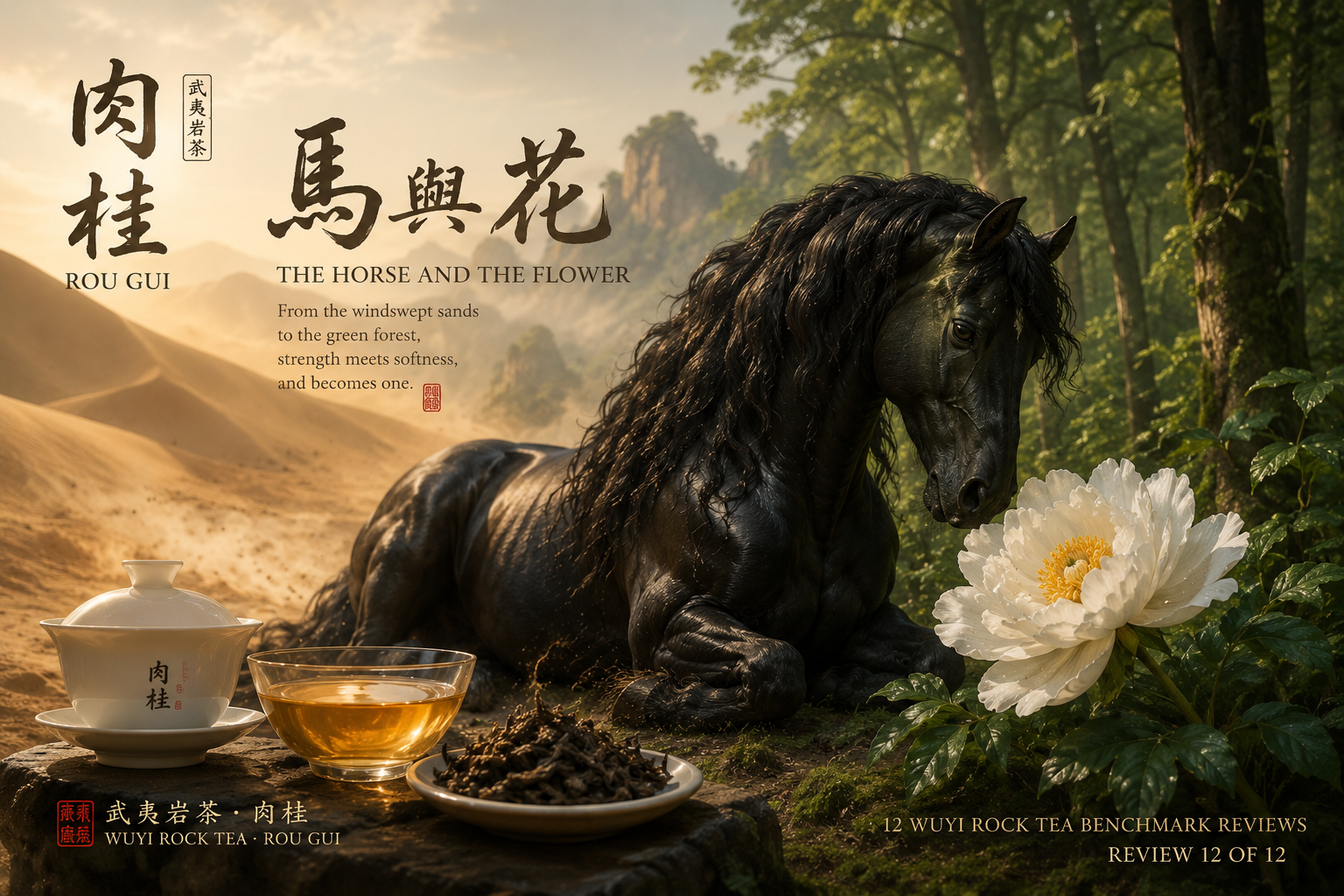
The twelfth and final tea in this Wuyi Rock Tea benchmark series moves from exceptional mineral force toward floral-honey sweetness and a remarkably soft, dew-like finish.
Tea at a Glance
| Tea | Rou Gui |
|---|---|
| Chinese / Pinyin | 肉桂 / Ròu Guì |
| Type | Wuyi Rock Tea (Yancha) |
| Origin | Wuyi Mountains, Fujian, China |
| Defining Character | Exceptional rock minerality, wood, char, cinnamon, floral-honey sweetness |
| Series | Wuyi Rock Tea Benchmark Review 12 of 12 |
| Overall Score | 75/100 |
Introduction
This Rou Gui marks the final tea in my current series of 12 Wuyi Rock Tea benchmark reviews. Of all the teas in the series, it produced one of the strongest impressions of rock minerality. Yet the session was not defined by strength alone: as the infusions progressed, that forceful mineral character gradually yielded to sweetness and softness.
The imagery was equally contrasting—a powerful black horse and a delicate white flower, initially occupying entirely different landscapes before slowly coming together.

Brewing Parameters
- Water: Volvic Natural Mineral Water
- Teaware: Mutton Fat Jade Porcelain Gaiwan
- Leaf: 5 g
- Water: 100–120 ml
- Temperature: 100°C
- Infusions: 9
Dry Leaf
The dry leaves carried a floral and cinnamon-like fragrance alongside the distinctive aromatic signature that makes Rou Gui immediately recognisable. They were dark charcoal brown, predominantly twisted strips with a mixture of larger leaves and smaller broken material.
Warm Gaiwan
Lid
Typical Yancha floral fragrance layered with wood and roast.
Cup
Earthy, with a floral fragrance. Interestingly, the distinctive cinnamon-like Rou Gui character of the dry leaves became less obvious once warmed, giving way to a familiar roasted Yancha profile.
After the Rinse
Lid
Woody and fruity, with a touch of char.
Cup
Sour plum, wet leaves and forest floor.
Tasting Journey
Infusion 1 — 8 seconds
The golden-amber liquor opens with rock minerality and char, followed by a light pear-like aftertaste. The mouthfeel is smooth and moderately thick, coating the tongue.
Infusion 2 — 8 seconds
Rock minerality remains prominent alongside wood and char. A bittersweet quality emerges in the aftertaste, while the liquor coats the whole tongue and gives the tea more substantial presence than in the first infusion.
Infusion 3 — 10 seconds
The rock minerality becomes noticeably stronger, accompanied by an increasingly pronounced bittersweet aftertaste. The coating sensation expands across the palate, now covered by pleasant sweetness.
Tea imagery: A strong horse appears beside a delicate peony. Strength and delicacy exist side by side.
Infusion 4 — 12 seconds
The rock minerality becomes exceptionally strong—possibly the strongest I can recall among the 12 Yancha reviewed in this series. Yet alongside that strength are remarkably gentle, sweet petals with a honey-like character. The contrast between the powerful horse and delicate flower becomes increasingly apt.
Infusion 5 — 15 seconds
Noticeable salivation develops and the imagery becomes clearer. The well-built, muscular horse has thick black hair and a heavy black tail, while the flower has very white petals surrounding a bright yellow centre. They still occupy different landscapes: the horse walks through windswept sands, and the flower sits quietly in a green forest. Then the two landscapes begin to combine.
Infusion 6 — 20 seconds
A strong mineral kick arrives immediately, followed by a very sweet aftertaste. The horse leaves the sand, walks toward the flower and enters the green forest. For the first time, it stands directly before the flower.
Infusion 7 — 30 seconds
The liquor begins to fade and the balance changes. Sweetness now overpowers minerality. The powerful horse bends its head and gently touches the flower with its nostrils. It is soft.
Infusion 8 — 45 seconds
The minerality transforms. What once felt strong and rocky now resembles sweet dewdrops resting on fresh leaves in the morning. The horse sits down and rests, quietly looking at the flower. The scene feels like a moving painting.
Infusion 9 — 60 seconds
The liquor fades to a much lighter golden yellow. The flavour remains essentially unchanged from the eighth infusion: soft, sweet and dew-like. The horse rests beside the flower in the green forest—a natural conclusion to the session.
Combined Infusions 1–9
Wood, char, strong rock minerality and a bittersweet aftertaste develop into increasing sweetness through the later infusions. The mouthfeel remains smooth and moderately thick, progressively coating the tongue and palate, while salivation becomes particularly noticeable in the middle infusions.
The defining characteristic is the contrast between power and delicacy. Minerality is among the strongest encountered during this 12-tea Yancha series, yet the tea ultimately moves toward floral-honey sweetness and a remarkably soft finish.
Wet Leaf Appearance
The spent leaves are predominantly deep olive brown to dark chocolate, with some considerably darker areas. They open reasonably well after nine infusions, although several remain folded or curled. Larger intact sections mingle with broken leaves and stems. Their dark appearance is consistent with the substantial roast character expressed throughout the session.
Wet Leaf Appearance: 7.3/10
Tasting Scorecard
| Attribute | Score | Notes |
|---|---|---|
| Dry Leaf Aroma | 6.0/10 | Floral and cinnamon-like; recognisable Rou Gui cultivar aroma. |
| Wet Leaf Aroma | 6.6/10 | Wood, fruit, char, sour plum, wet leaves and forest floor. |
| Floral | 6.8/10 | Develops into a soft, petal-like character. |
| Fruit | 5.8/10 | Sour plum and a light pear-like aftertaste. |
| Spice | 6.8/10 | Clear dry-leaf cinnamon fragrance. |
| Minerality | 9.2/10 | Exceptional rock force; possibly the series’ strongest mineral expression. |
| Sweetness | 8.6/10 | Soft petal-like honey eventually overtakes minerality. |
| Bitterness | 6.0/10 | Pleasant bittersweet structure rather than aggressive bitterness. |
| Roast | 8.0/10 | Persistent wood and char support the developing sweetness. |
| Body | 8.0/10 | Smooth, moderately thick and substantial. |
| Mouthfeel | 8.4/10 | Expansive coating sensation with noticeable salivation. |
| Finish | 8.8/10 | Long mineral-sweet finish becoming soft and dew-like. |
| Yan Yun | 8.2/10 | Powerful rock character evolves into floral-honey softness. |
| Longevity | 7.5/10 | Nine expressive infusions without collapsing into thinness. |
| Cha Qi | 7.2/10 | Calming and relaxing, with salivation; sleepiness may reflect general tiredness. |
| Overall Impression | 7.5/10 | Powerful yet elegant, defined by exceptional minerality and its transition into softness. |
Strengths
- Exceptional rock minerality—among the strongest in the 12-tea series.
- A compelling evolution from wood, char and bittersweetness into floral-honey sweetness.
- Coating mouthfeel, noticeable salivation and a long, soft finish.
- Nine enjoyable infusions with a clear narrative arc.
Considerations
- The substantial wood and char character will best suit drinkers comfortable with firmly roasted Yancha.
- Fruit is secondary to minerality, roast and sweetness.
- The late-session liquor becomes visibly lighter even as it retains its sweet expression.
The Horse and the Flower
The imagery developed alongside the flavour. At first were two opposing characters: a powerful, muscular black horse representing strength and structure, and a delicate white flower with a yellow centre representing floral sweetness. They even occupied different worlds—windswept sands and a green forest.
As minerality softened and sweetness increased, the landscapes merged. The horse left the sand, entered the forest, approached the flower, gently touched it and finally rested beside it. Strength did not disappear. It became gentle.
Final Reflection
This Rou Gui is a fitting conclusion to the 12-tea journey. Wood, char and bittersweet minerality dominate the early and middle infusions before floral-honey sweetness increasingly emerges. By the later infusions, sweetness overtakes mineral force and the tea finishes with a soft, dew-like quality.
World Tea Verdict
- Overall: 75/100
- Best For: Yancha drinkers seeking emphatic minerality balanced by late-session sweetness.
- Series Position: Review 12 of 12 and a fitting final benchmark.
- Recommend: Yes, particularly for lovers of roasted structure, rock rhyme and evolving sweetness.
Brewing Recommendation
Use 5 g in a 100–120 ml gaiwan with Volvic or similarly balanced mineral water at 100°C. Begin at 8 seconds for the first two infusions, then extend through 10, 12, 15, 20, 30, 45 and 60 seconds. This progression preserves the early mineral power while fully revealing the floral-honey and dew-like finish.
发表评论