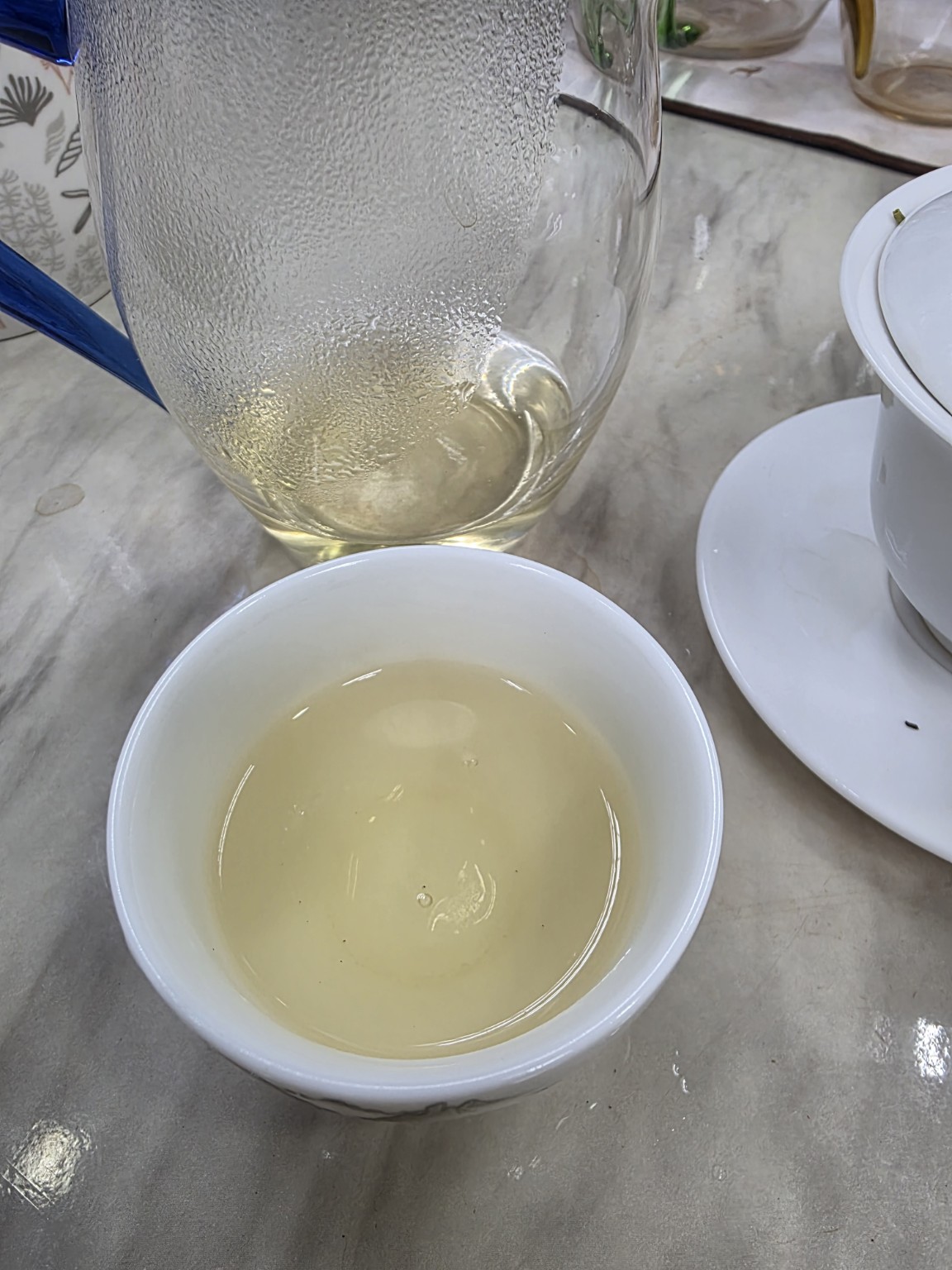
Tasting date: 23 September 2026
By the fourth infusion, this Huoshan Huangya felt like a broth a chef had prepared, purposefully leaving in large mung beans with their skins intact. A natural, whole appreciation of the bean. A different recipe of tau suan.
That image stayed with me through eleven infusions. The beans began soft and disintegrated, grew whole and substantial with a little bitterness from their skins, then slowly broke down again. Towards the end, there was more sweet soup than bean.
The tea and the setup
The packaging identifies this as 2026 Huoshan Huangya (霍山黄芽), a yellow tea from Lu’an, Anhui, graded 特一级 (Special Grade 1). The production date is 8 April 2026, and the pack contains 125 g.
I brewed 5 g in a 90 ml porcelain gaiwan, using Volvic mineral water at 90°C throughout. The eleven infusion times were 10s, 15s, 20s, 20s, 20s, 25s, 30s, 40s, 50s, 60s and 90s.
Before the first pour
The dry leaves had a floral, orchid-like fragrance. In the warmed gaiwan, both the lid and the cup smelled of warmed soybeans or edamame. Already, the aroma had moved from flowers towards beans.
Eleven infusions
1 · 10 seconds. Soft, with tau suan or mung bean flavour, and the same flavour in the aftertaste. The liquor was very pale, clear yellow. The beans felt cooked until they were beginning to disintegrate into the soup.
2 · 15 seconds. The colour was slightly darker. A slight bitterness appeared, then quickly faded. The “beans” in the tau suan now seemed like whole beans with a bite to them, rather than the more disintegrated beans of the first infusion.
3 · 20 seconds. The bitterness was more present and stayed now. It seemed like the skin of the bean. The liquor became fuller-bodied, with larger beans, and a bitter aftertaste that came with them. Moderate tongue coating began here and continued through the middle infusions.
4 · 20 seconds. The taste stabilised. This was like a broth a chef had prepared, purposefully leaving in large mung beans with the skin intact as a natural, whole appreciation. A different recipe of tau suan.
5 · 20 seconds. Stable, with the lingering bitter and mung bean aftertaste. The tongue coating remained moderate.
6 · 25 seconds. Still stable. The chef keeps refilling our bowls so we can be filled.
7 · 30 seconds. The bitterness started to slowly give way until sweetness remained. The whole mung bean and tau suan profile was still there, but lighter. Now there was almost the same amount of “gravy” and beans.
8 · 40 seconds. More sweetness now, with the bitterness subsiding further. We were scooping into the disintegrated beans, now that the fully formed beans with their skins were almost fully consumed.
9 · 50 seconds. More of the disintegrated tau suan with the soup. Sweeter.
10 · 60 seconds. Almost just the sweetness left, with some tau suan flavour.
11 · 90 seconds. Bland and sweet. A natural place to finish.
Spent leaves and a final impression
The spent leaves were supple, with a slight vegetal fragrance.
What stays with me is that different recipe of tau suan: soft mung beans, then whole beans with their bitter skins, the chef refilling the bowl, and finally the disintegrated beans mingling with an increasingly sweet soup. It began with orchid and warmed edamame, but it was the bowl of beans that carried the session.
发表评论